Join a community of readers who are committed to Jewish stories
Sign up for JBC’s Nu Reads, a curated selection of Jewish books delivered straight to your door!

Memorial Tablet and Omer Calendar (cropped), Baruch Zvi Ring, 1904. Jewish Museum, via WikiMedia Commons
One morning in late March 2019, a quiet but extraordinary thing happened to me that precipitated my embarking on the ancient Jewish practice of Counting the Omer.
My son had just come out of a residential treatment center (due to complications from his depression) and was looking for a short-term rental in Boston. Fortunately, he found an ad for a furnished apartment, available immediately.
Accompanying my son, we met Nate, the young man who was subletting the apartment. Nate had an easy manner and smile. We learned he was a senior at the nearby college, a philosophy major, graduating in May. The place was perfect — two rooms, fully equipped kitchen, and a separate living/bedroom area. So perfect, I wondered, why was he leaving now?
“May I ask why you’re subletting so close to graduating?”
“I just got out of a psychiatric hospital,” Nate said, without hesitation. “They felt it would be better if I went back to living in the dorm with other people.”
This stunned me, but my son didn’t miss a beat. He put out his hand to shake Nate’s, and told him that he too had also just come from a residential treatment center. These two sensitive men in their twenties had a brief and beautiful moment of connection. I felt overcome with admiration and respect for their honesty. I knew too well the complexities of mental health struggles for young adults, how people rarely talked openly about these things.
Nate handed our son the key. I wrote Nate a check for April.
After a few weeks, however, our son realized he needed more support and entered another program in another state. When I met Nate to return the key, I mentioned that he hadn’t yet cashed the check for April.
“I ripped it up,” he said. “I don’t have to pay for the apartment anyway, and I wanted to do something good for someone else.”
My eyes filled up. “Are you sure?”
He nodded and said he felt bad for our son and wished him well. He added, “I wish I could have been more present for him.”
We were standing outside the apartment building. It was a mild April day in Boston, with a blue sky and bright sunshine that makes you feel hopeful after a long winter. I responded, “This is so kind of you. I hope you know how special you are.”
Nate then shared that he had gone through a kind of rebirth. “It sounds hokey, but I believe love and goodness will save the world.”
“I don’t think it sounds hokey at all,” I said. “If only the rest of the world would listen. I’m so touched by your kindness; I’m going to tell every person I meet. Your kindness will have a ripple effect.” We hugged. Our business was done. He planned to move west after he graduated.
That afternoon, I met my friend Risa Miller for a walk. Risa’s a wonderful novelist. On our walks, we typically discussed our works-in-progress and inevitably Judaism would find its way into our conversation. She’s an Orthodox Jew. I think of myself as a non-traditional, spiritual Jew.
As with all of my novels, I am drawn to emotional dilemmas in relationships. In my newest novel, Evening Begins the Day, I was exploring themes of trauma and betrayal in families. Set in contemporary times, I knew I wanted to add a layer of spirituality to the story but I didn’t know how it would show up or what it would look like. Whenever I face this kind of conundrum in my work, I intentionally remind myself to have faith and stay open — kind of like a prayer — and trust that the universe will deliver an answer to me. Hopefully soon!
I was telling Risa about Nate — how his kindness had given me chills. I felt tears rising yet again. It was then that she made a comment about how Nate’s interaction reminded her of the Counting of the Omer.
I must pause here to confess: I had never heard of the Counting of the Omer. Growing up in the sixties, I attended a Reform temple every week until I got confirmed in the ninth grade. My grandmother was a devout Orthodox Jew. In my adulthood, I acknowledged major Jewish holidays but rarely attended services. I hadn’t a clue about the Counting of the Omer.
Risa explained it was a seven-week practice that started every year on the second night of Passover and addressed Kabalistic themes, such as charity and kindness. Dating back 3,000 years, it entailed counting forty-nine days out loud and included special blessings. (This year, the Counting starts on the evening of April 2nd and ends at nightfall on May 21st.)
I was intrigued. After our walk, I hustled over to the Jewish bookstore in my town (a version of which appears in my novel) and found a primer on the Counting of the Omer by Rabbi Simon Jacobson, designed by Rae Shagalov. The introduction listed descriptions of the seven emotional attributes inspired by the Kabbalah: lovingkindness, discipline, beauty, endurance, humility, bonding, and nobility. Each week and each day of the forty-nine days is dedicated to a combination of two of these seven attributes. So, for example, on day two of week one, the attribute of discipline (day two) is folded into lovingkindness (week one). After reciting the week and day, participants can consider what discipline in lovingkindness means and how it plays out in their lives.
Back home, I devoured the book. This was the missing element I’d been searching for, one that could connect my characters to something outside the confines of time and space and offer them a chance to rise above the trials of their quotidian lives. As I delved deeper, it struck me that this ancient ritual of self-reflection — as I interpreted it — could adapt easily to contemporary situations and offer healing insights to anyone willing to give it a try.
As for Nate, I can’t recall his last name (because he had ripped up the check), but I can honor the promise I made to myself – to share the power of his kind gesture and compassion.
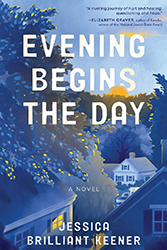
Evening Begins the Day Jessica Brilliant Keener
Jessica Brilliant Keener’s debut novel, Night Swim, was a national bestseller. Her second novel, Strangers in Budapest, was an Indie Next pick and “best new book” selection by Entertainment Weekly. She has won numerous writing fellowships and published over 100 features in national publications, including Lilith, The Boston Globe, and the anthology: Alone Together, winner of the 2021 Washington State Book Prize.