Join a community of readers who are committed to Jewish stories
Sign up for JBC’s Nu Reads, a curated selection of Jewish books delivered straight to your door!
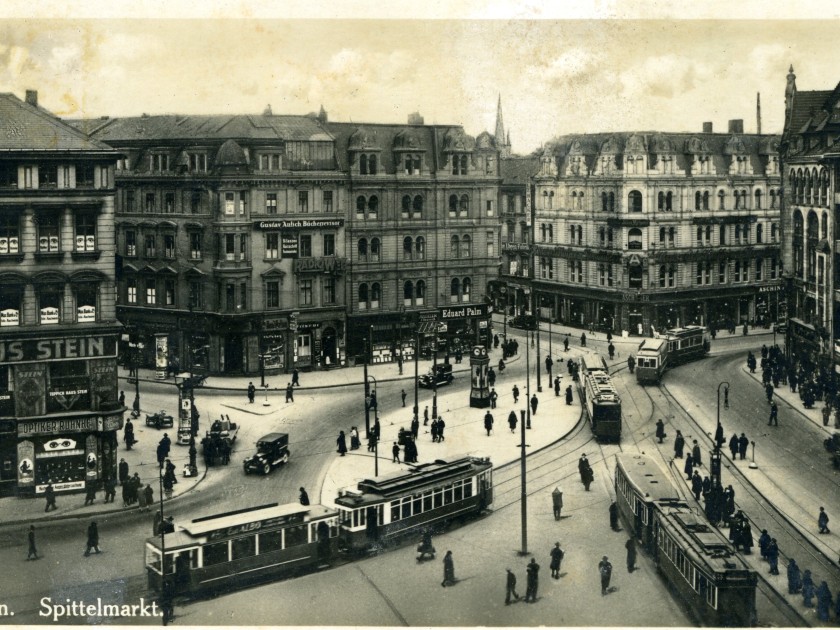
Postcard of Berlin, Spittelmarkt 1930s
Tauentzienstrasse shakes as the giant double-decker buses rumble from one stop to the next, like houses on wheels. One streetcar follows another. They whiz past, ringing their bells, demanding the right of way as best they can amid the unbroken procession of automobiles.
At midday all the company managers — major ones as well as their minor counterparts — get in their cars and set out to eat. They are in a hurry and let that be known. They honk and toot their horns all at once, gnawing away at the pedestrians’ nerves.
The stench of gasoline and exhaust fumes poisons the air.
How wonderful it is to sit cozily in an automobile. Clouds of dirty smoke come billowing out of the exhaust pipe, while you sit in front, oblivious, press your foot on the gas pedal, and rush ahead. It’s only the others, the people you don’t know, those of little importance, who have to breathe in the gas along with the air.
Of course filling the streets with so much smoke is forbidden— drivers have an obligation to spare the lungs of pedestrians, but they don’t give that a second thought. They don’t have time for second thoughts. They charge ahead, leaving the stench behind them.
My God, they think, so many things are illegal. So many regulations confining every motorist like so many fences. After all, drivers are sportsmen, too, even if only on a small scale. They also know that the restrictions hurt only if they’re caught. Still, being a motorist isn’t easy. You have to shell out for taxes, pay much too much for gas, and on top of everything else you have to keep your eyes peeled for every kid kicking a ball on the street.
Meanwhile the traffic cop on the corner has other worries. He’s yelling at a woman who’s blocking the flow of traffic. These damned pedestrians. All they do is hold things up, dithering this way and that, but of course there’s hell to pay if somebody accidentally flattens one of these tiresome two-legged creatures.
The traffic light orders the cars to halt. They line up in rank and file. Finally the color changes, and like a herd of wild beasts they stampede forth. Onward! The battle cry of the metropolis rings out through the streets.
The streetcars sound their bells hysterically, while the buses emit a dull rumble, and the bicycle ringers give out a weak trring-trring. The cars and trucks produce a music all their own, a mix of darker and lighter tones. Onward!
Whatever other regulations might be in place, there are no restrictions on noise in Berlin. That much is clear.
______
On a pitiful, trampled bit of grass set in the middle of the asphalt, Frau Fliebusch sat perched on a bench and stared blankly at the traffic. Frau Fliebusch did not understand the times. Frau Fliebusch was the woman from yesterday.
Frau Fliebusch was around sixty years of age. She was not a wealthy woman, at least not anymore, and that was evident. She was dressed poorly and very much out of fashion. Her outfit would have passed for modern around the turn of the century, or perhaps ten years later. Her long skirt grazed the street and had been sweeping up the dust for years. Its gray color matched the gray of her face, and the grime that clung to it like a broad border dragged it to the ground. Her jacket came down to just above her knee. It had once boasted purple stripes, and a purple shimmer still shone through the fabric.
While the wheel of fashion had not been kind to her outfit, her hat was now once again very much in vogue. It was large and yellow and shaded Frau Fliebusch’s face. A broken feather — actually all that was left was the shaft — lent a note of near frivolity. But the wearer was anything but frivolous. To call her melancholy would be an understatement.
Frau Fliebusch no longer understood the times, and that was her misfortune. Her mind was still stuck in the years before the Great War. Everything that came later, everything she found inimical — the war and the inflation and all the consequences of the war, the entire wickedness of recent times — had rushed past her like some horrible dream.
She didn’t believe it. She didn’t believe it was all true. That it was the sober, everyday reality. The same way that to this day she hadn’t grasped that Fliebusch, Wilhelm Fliebusch, her strong, handsome Wilhelm, had fallen victim to a grenade. Or that her savings, her sixty thousand marks, had lost their value.
She knew for a fact that Wilhelm was alive; she could feel it. Because Wilhelm had never been sick. In fact her handsome Wilhelm had been extraordinarily healthy. He couldn’t have been healthy one day and dead the next. That was impossible. It was only a plot against her, against Frau Fliebusch, née Kernemann. And the fact that the sixty thousand marks that had been her dowry was suddenly worth less than a pfennig? That too was a plot against her, and she had said as much to the director of the bank.
Wilhelm was being held somewhere, but he would come back one day, and one day she would also recover her money. The whole nightmare would soon be over. It was obvious: People were making fun of her. Everyone was dreaming up mean things aimed against Frau Amalie Fliebusch and planning to carry them out. They kept trying to convince her that Germany no longer had a kaiser. She wouldn’t have minded if that were the case, but of course it simply wasn’t true! That was just another plot to confuse her, which was why she no longer read any newspapers: They, too, were full of lies.
It had all happened so quickly. From one day to the next, people she had known to be nice and kind had turned into schemers and villains, and Amalie Fliebusch was still wondering why. At the same time everything was as it had always been. She had gotten up around ten in the morning and at Wilhelm’s behest had drunk some chocolate, so that she might have a fuller figure, when all of a sudden some people showed up — some officers, friends of her husband she’d known a long time. Then they tried to tell her that Wilhelm was dead.
Frau Fliebusch angrily banged her umbrella against the edge of the bench. She couldn’t think about it without getting worked up.
At first she had fainted. Later, after she came to, she realized that it was all a lie — a stupid, mean lie. But the terrible thing was that the people kept on lying, without stopping, and somehow Wilhelm had to be in league with them. She hadn’t heard a single word from him! He was completely silent. Instead they sent her his uniform. She had it with her. She kept it right next to her in the small suitcase.
Wilhelm was acting very unfairly. And she was going to tell him that, too. But could anyone be mad at Wilhelm for very long? Certainly not Frau Fliebusch! She smiled, touched by the thought of him. Wilhelm was always so attentive. He never came home without bringing her something. Flowers or something sweet. Frau Fliebusch sighed. Hopefully the whole nightmare would soon be over. Hopefully Wilhelm would soon be home.
People were getting stranger and stranger. They pulled away from her like ships departing a harbor. It was hard being the only rational person in a world full of fools. But how could she possibly play along? What would Wilhelm think of her if she, too, suddenly turned into a fool?
People were getting stranger and stranger. They pulled away from her like ships departing a harbor.
People told her she should go to the poorhouse. But what would Wilhelm think if his wife, the daughter of Headmaster Kernemann, listened to the fools and went to a poorhouse? No. Wilhelm would never forgive her for that, she was certain. That was something he would never forgive.
Frau Fliebusch felt hungry. It was time for her midday meal. She did receive some assistance from Fräulein Reichmann, who gave her ten marks every week.
Fräulein Reichmann used to be a nice person. A kindhearted soul, even, thought Frau Fliebusch. Despite being ten years younger than Frau Fliebusch, she had always been her best friend. But then even Fräulein Reichmann had joined the liars and maintained that her own fiancé had fallen in the war. Ostensibly she was now living off her private tutoring, or so she told Frau Fliebusch. The daughter of Director Reichmann. While every child knew that Director Reichmann was a very wealthy man. For whom ten marks a week was nothing.
It was pitiful. And it was mean of Fräulein Reichmann, when she knew very well that Wilhelm would pay back every pfennig. And what was the result? Frau Fliebusch was forced to sleep in shelters and train stations, alongside people who were utterly impossible, simply because Fräulein Reichmann was so unkind to her.
Frau Fliebusch rose from the bench, indignant as she always was when she had these thoughts. Right beside her were the two bags she dragged along wherever she went. One contained Wilhelm’s uniform as well as the new top hat he’d purchased just before he had to leave, while the other was full of her own clothes.
Frau Fliebusch looked around, undecided. Where should she go?
The crazy people were now running newfangled restaurants where you could pull a roll out of a machine. You put ten pfennig in a slot and then a disk turned and you could reach in and take a roll. The things people come up with! But Frau Fliebusch was no longer surprised at anything. She divided the world into the mean acts and dirty tricks that were clearly directed at her, on the one hand, and things that were indifferent, on the other.
Frau Fliebusch made her way down Tauentzienstrasse, clutching a bag in each hand. The passersby eyed her in amazement. Many recognized her by sight.
Go on and gape, thought Frau Fliebusch. Just you go on gaping. I know how despicable you all are.
Ulrich Alexander Boschwitz was born in Berlin in 1915. He fled Germany in 1935 and wrote his novels while studying at the Sorbonne in Paris. In 1939, he settled in England, but after the war broke out, England interned him as an “enemy alien” — despite his Jewish background — and shipped him to Australia. In 1942, Boschwitz was allowed to return to England, but his ship was torpedoed by a German submarine, and he was killed at the age of twenty-seven.
Philip Boehm has translated more than thirty novels and plays by German and Polish writers, including Herta Müller, Franz Kafka, and Hanna Krall. For these translations, he has received numerous awards, including NEA and Guggenheim fellowships and most recently the Helen and Kurt Wolff Translator’s Prize. He also works as a theater director and playwright.