Join a community of readers who are committed to Jewish stories
Sign up for JBC’s Nu Reads, a curated selection of Jewish books delivered straight to your door!
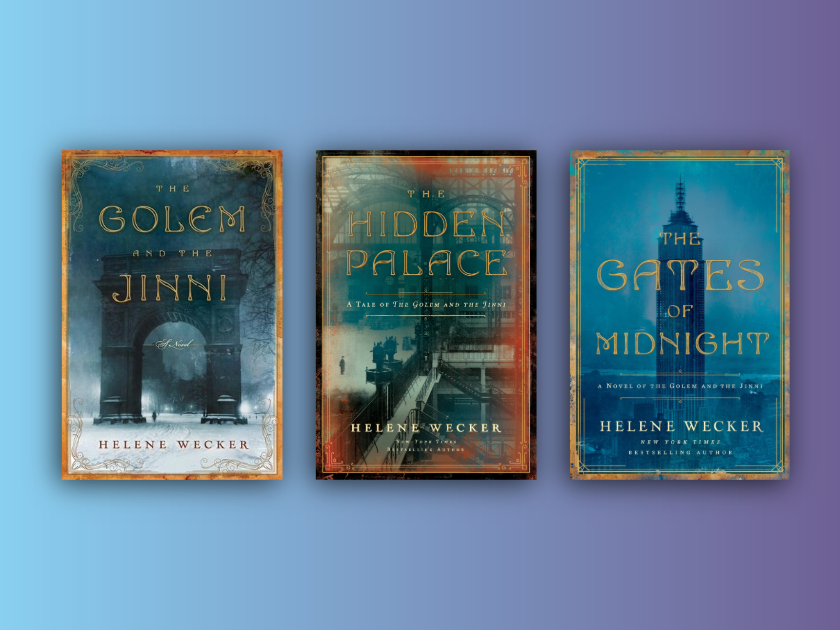
I write historical fantasy novels, which means I spend an awful lot of time on research.
I fell into this particular aspect of my career completely by accident. I was a graduate student when the idea for my first novel, The Golem and the Jinni, came to me. I chose 1899 Manhattan as the setting pretty much on a whim. I didn’t realize at the time just how much I’d need to learn in order to write my tale of Chava, the golem, and Ahmad, the jinni, two supernatural immigrants who must learn how to survive in a human world.
What followed was a crash course education in early-twentieth-century New York City, first for The Golem and the Jinni, then its sequel, The Hidden Palace, and finally the conclusion to the trilogy, The Gates of Midnight. My research accumulated in layers, like an oil painting. I began with an overview of the city and its neighborhoods, the social tensions of the day, and other larger issues faced by its inhabitants. Then, once I had a solid foundation, I looked for more specific details to add texture and color. This is always a tricky job, since it’s easy to drown a story in all the fascinating bits of research I encounter. When readers ask how I decide which particulars to use, I usually talk about the small details that tell a bigger story. Like the pharmacists who kept clocks on their counters, so their customers — many of whom couldn’t afford pocket-watches — had a reason to stop in while running their errands. Or how you could tell if someone had spent the night beneath the elevated train tracks by the cinder-burns and soot marks on their clothing.
It’s not a bad answer, I think; but lately it’s occurred to me that it’s incomplete. I ought to say that with enough research, it’s possible to build not just vivid settings but entire characters. Which means that really, I ought to tell them about Kreindel Altschul.
At first, I only created Kreindel because The Hidden Palace needed another golem.
The plot of The Hidden Palace involves Chava and Ahmad meeting others like themselves: a male golem and a female jinni, respectively. A fun idea, I thought, but then came the logistics. Who would be this new golem’s master? A child, I decided. (I don’t remember why exactly; it’s very possible that I was influenced by Paul Wegener’s 1920 film Der Golem, with its arresting image of a little girl offering an apple to the titular monster.) But that only led to more questions. How had the child ended up with the golem? Where would she keep it? What on earth would she do with it?
The best thing about historical research (besides its endless opportunities for procrastination) is that once you’ve learned enough about a particular time and place, the story and the research start to attract each other like magnets. And as I pondered the problem of the little girl and her golem, I began to think more and more about the Hebrew Orphan Asylum.
I’d first learned about the Hebrew Orphan Asylum while reading about the disparate Jewish communities in Manhattan and how they perceived each other. Two of the most dissimilar of these communities were the long-established Reform Jewish families of the Upper East Side and the more recently arrived Orthodox Jews of the Lower East Side. The two communities clashed with each other, often bitterly, over the question of assimilation. For many recent immigrants from the Old World, to adapt to a “more American” existence would be a repudiation of the way of life that had sustained them through repression and pogroms. The much more cosmopolitan Reform Jews, meanwhile, tended to view America’s modern customs and liberties as opportunities to be seized for the benefit of all.
Chava and Ahmad are decidedly the central characters of The Golem and the Jinni trilogy, but the spiritual heart of the tale might belong to Kreindel.
The Hebrew Orphan Asylum was one of the most visible symbols of this conflict. Established by a committee of Reform benefactors and advisors, the H. O. A. took in children from destitute Orthodox families and raised them in a curriculum of Reform liturgy and American civic engagement. The H. O. A. was literally a lifesaver for any number of children, thanks to the medical attention and proper nutrition it made sure they had, but the children lost precious links to their families, such as their mastery of Yiddish, and often left the orphanage feeling alienated from the Orthodox world and unsure of their place in the Reform one.
The more I considered the Hebrew Orphan Asylum, the more it seemed to fit perfectly into the story I was writing. I’d already decided that assimilation would be a primary theme of The Hidden Palace, and I needed somewhere for this little girl and her golem to live. And wouldn’t a looming Gothic orphanage in Hamilton Heights make for a fabulous setting? The little girl became Kreindel Altschul, the daughter of an Orthodox rabbi; the golem’s name was Yossele. Her father had built Yossele before perishing in a tenement fire, leaving Kreindel as Yossele’s master. And then, of course, where should Kreindel end up but at my lightly fictionalized version of the H.O.A., with her hulking companion hidden away in the basement?
With that resolved, I began the process of turning Kreindel from a plot device into a true character in her own right. Slowly, over drafts and rewrites, she became a neglected prodigy, a silent, watchful girl who teaches herself to read Hebrew and study Talmud, even helping her father build Yossele when it becomes clear that he can’t accomplish it alone. By the time that Chava arrives at the Hebrew Orphan Asylum and meets Kreindel (and, more catastrophically, Yossele), Kreindel is a young woman of eighteen, stubbornly keeping to her father’s traditions while longing for the educational opportunities available to Reform women. Yossele, her ever-watchful guardian, is her only friend as well as a dangerous responsibility. At the novel’s end — don’t worry, I won’t spoil the good stuff — Kreindel is still unsure of her path, but no longer has to manage it alone.
By the time I finished The Hidden Palace, I’d grown so attached to Kreindel that when it came time to write the last book of the trilogy, I knew I had to bring her back. In The Gates of Midnight, Kreindel is now the headmistress of an Orthodox girls’ orphanage in Brooklyn, and she’s just as stubborn as ever. Her contentious relationship with the orphanage’s head rabbi puts her job at continual risk; she’s increasingly isolated in her private life as well, especially after she and Chava have a painful falling-out. Her faith and her studies sustain her, but her insistence on independence puts her at the fringes of her community. Above all she longs for a way to be herself without contradictions, and for wholeness after a lifetime of loss and conflict — a desire that will tempt her into dangerous territory before the story’s end.
Even now, when I look back, I’m a little flabbergasted by Kreindel Altschul. I can trace every step of how she was built — the plot dilemma, the film still, the heaps of research — but what accounts for her steadfast faith, her iconoclast spirit? Did she add those herself, when I wasn’t looking? Kreindel only ever existed in my head, and yet I find myself hoping that she likes the ending I wrote for her. Chava and Ahmad are decidedly the central characters of The Golem and the Jinni trilogy, but the spiritual heart of the tale might belong to Kreindel.
Helene Wecker is the bestselling author of The Golem and the Jinni, The Hidden Palace, and The Gates of Midnight. Her books been translated into over a dozen languages and have won awards such as a National Jewish Book Award, the VCU Cabell Award, and a Golden Poppy. She lives in the San Francisco Bay Area with her family.