Join a community of readers who are committed to Jewish stories
Sign up for JBC’s Nu Reads, a curated selection of Jewish books delivered straight to your door!
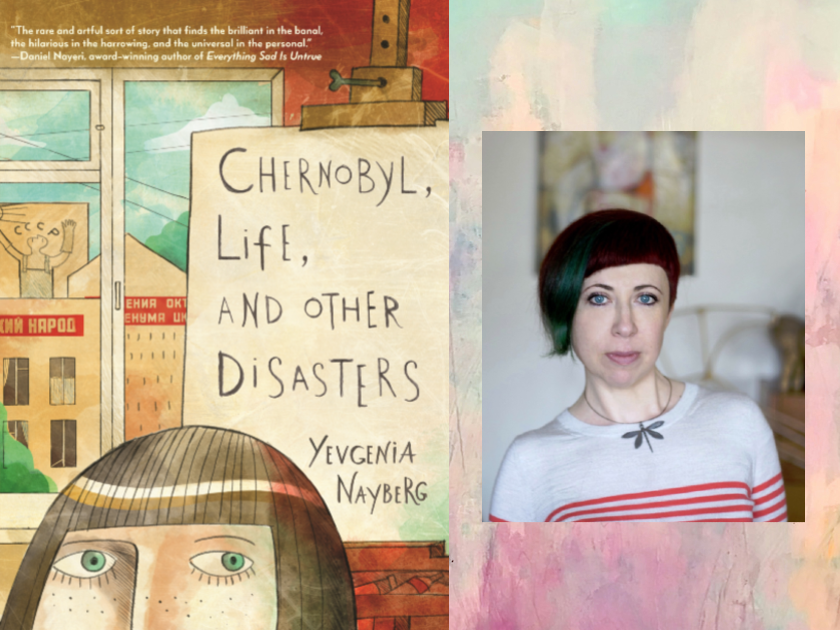
Emily Schneider speaks with acclaimed author and illustrator Yevgenia Nayberg about her new graphic memoir, Chernobyl, Life, and Other Disasters. They delve into Nayberg’s depiction of her family, her experiences with Jewish identity and antisemitism in the Soviet Union, and how she structured her stunning new work.
Emily Schneider: Yevgenia, most people, looking back on their childhood, remember some event as being a disaster. In your life, the Chernobyl nuclear incident in 1986 overlapped with your approaching adolescence, and applications to art school. How did you decide to structure your new graphic memoir (Chernobyl, Life, and Other Disasters) around these events?
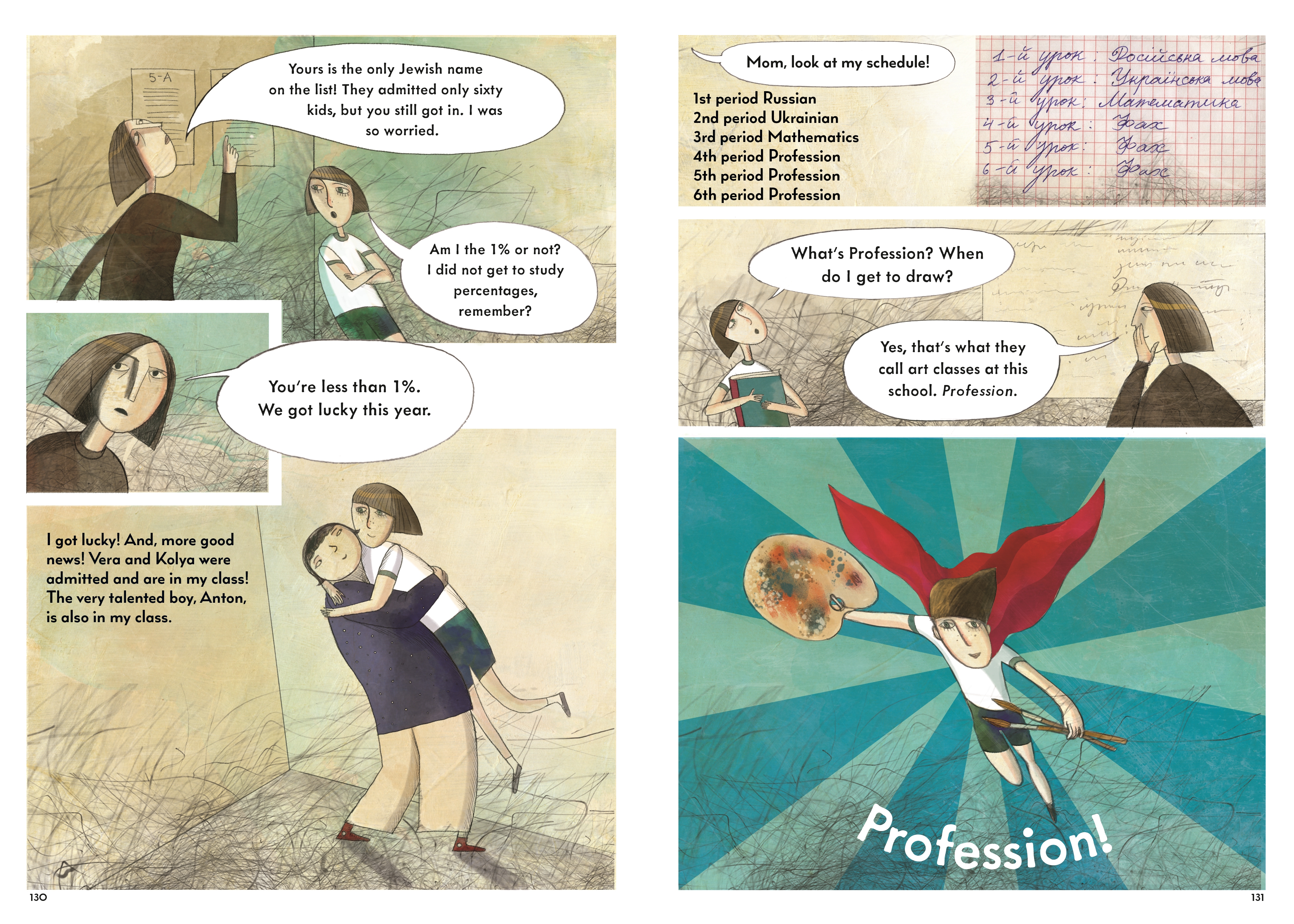
Yevgenia Nayberg: Well, for me, it turned out to be a blessing in disguise, in a way, because of how it affected the Jewish quota for that year. When you read the book, you know that my mother was prepping me for the fact that I may not ever get into art school because of the quota. Due to Chernobyl, there weren’t enough people that applied, so I was able to get in. I’d like to think that I was able to get in because of my marvelous talents, but there was this other component. Obviously, it was a big disaster, but, ironically, it created a stepping-stone moment for me and my career as an artist.
ES: In reading the book, it struck me that you don’t mention Jewish identity on every page, but it’s always implicitly there. How did you decide to frame your coming-of-age memoir as an artist around Jewish identity and antisemitism?
YN: It’s such a huge part of my identity. It has always been and sometimes, as you know from the book, I wish it wasn’t always omnipresent. It wasn’t the focus of the memoir, but I could not avoid it because encounters with antisemitism were such a big part of my life growing up. I left Ukraine when I was nineteen. It would have been a different book; I didn’t want to steal from the main focus, but it is completely unavoidable. Antisemitism is such a huge part of growing up Jewish in the Soviet Union, that it just would not have been honest to ignore that component altogether.
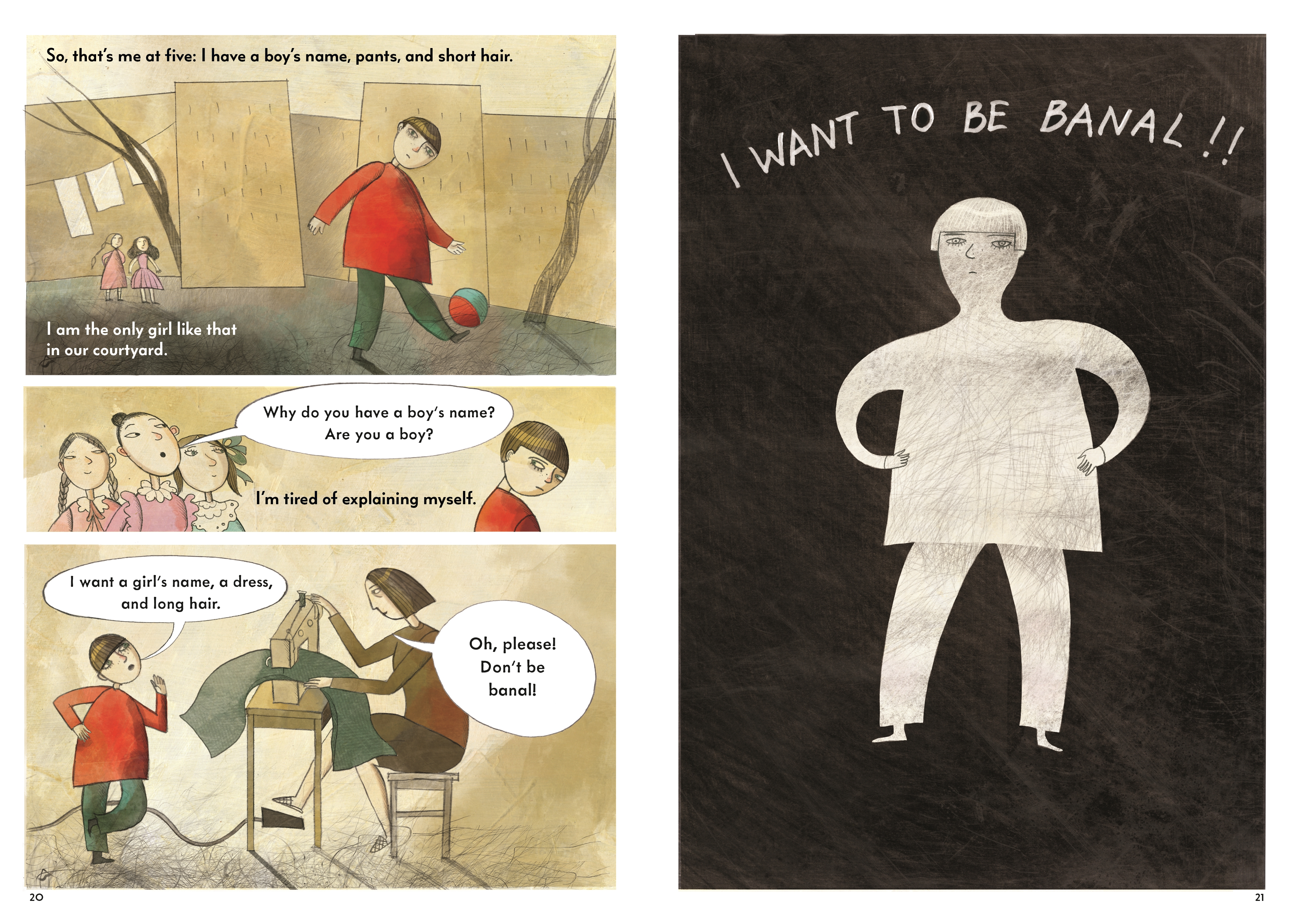
ES: There is an unforgettable scene where Genya (Yevgenia) has learned that she’s Jewish from two bullying schoolmates and she has a conversation with her mother about it. There is an economy of language, and also of gestures. Mother and daughter are viewed from different angles in each frame. Genya begins, “Mama, am I a Yid?” “Who told you that?” “The fat Lena and the small Lena.” You condense the whole range of antisemitism with that one phrase; it’s terrific. How did you incorporate into Genya’s character her Jewishness, being an artist, being left-handed, having a first name more typical for boys, as well as other ways that you repeatedly refer to yourself as being different?
YN: I am myself and I’m also the character, and they are slightly different. In my own six-year-old world, having a boy’s name, short hair, and being Jewish, all had the same kind of weight. As an adult, I thought that was an interesting comic twist. For the adults reading the book, especially for Jewish adults, they understand what it actually means, when a child says, “Oh no. If it wasn’t enough that I had to wear pants, now I’m also a Jew!” So, of course, there is this tongue-in-cheek way of describing something that is really huge. For many Soviet kids, we all remember that moment when we learned that we were Jewish, and it was never a nice or celebratory moment. It’s always an instance when someone outside your family, someone in the building courtyard, would let you know in the most disgusting way. And then you bring it home, and it’s always a spontaneous, sudden conversation that a lot of family members would dread and wouldn’t know how to approach.
ES: Throughout the memoir you communicate on multiple levels at once, so that if you’re an adult reading the memoir, you identify with the anxious parent, while the child is thinking, why won’t you answer my question? Another instance of this duality is when Genya’s mother tries to explain to her why she has to make a piece in an academic art style, “Young Pioneers Fixing the Playground,” to even have a chance to get into the school. At which point, she might have the chance to produce experimental art that feels genuine to her. How did that paradoxical, artistic advice affect your development as an artist?
YN: Overall, Soviet life was made out of this duality, and everyone understood it very early on. People telling jokes about the government at home, but then taking it seriously in real life. And I think this is something that the American audience, at least older readers, may be able to understand quite well, just, the need to be careful, and not say something that could be taken the wrong way. When you grow up with this, you don’t even question it. I knew that I had to behave in a certain way. It was something that was required for me to move forward as an artist, and I was just hoping that I’d be able to do whatever I wanted after. There is a moment about it in the book where I come home from the exams, exhausted from working on the “Young Pioneers Fixing the Playground,” and I can finally be myself and draw what I love. That was always present. I feel like everyone was understanding of that. I’m sure there were people who really believed it, but I don’t know anyone in the Soviet intelligentsia environment who were real believers in communism, or believed that whatever they heard on the radio was true.
ES: That duality also reminds me of your perception of your grandfather. You assumed he worships Brezhnev, and then, unbelievably, when Brezhnev dies, he doesn’t seem to be particularly upset.
In the memoir, parents, grandparents, and siblings, are a protective circle around you, but they’re also, at the same time, obstacles to your aspirations. How did you write about your family members without sentimentality?
YN: I think it’s the key word that you just used. As I was writing, I realized that the only way to write a good memoir is not to be sentimental about your childhood. I think once you become cute or wistful about the child that you were you can no longer write honestly. I wanted to have this remove. Not a cold look, obviously, I sympathize with Genya, and my family, but I never thought of her (or myself) as this cute little charming girl. I just wanted to be honest, realistic, and sarcastic, so a part of her character is myself today, just looking at this precocious child, but not thinking sweetly of her or of my family members. Although it’s very hard, because I love them dearly, those who are still living, and those who are no longer here. It’s tricky, because as I was writing I did want to heighten them, to make them look better. But I don’t think I made them look bad. I just made them complicated and interesting, and I think that’s the key to writing an honest memoir.
ES: So much of your earlier work echoes in this book. In Anya’s Secret Society, a left-handed child in Russia copes with prejudice and dreams about an alternative world populated by left-handed artists. In A Party for Florine, an immigrant Jewish girl identifies with Florine Stettheimer, an unconventional feminist artist from a previous generation. And in I Hate Borsch!, a child in America comes to love a food that, in her previous homeland, she really disliked. You always identify with the outsider. Being Jewish and an artist, how important is that outsider status to your work, and to this memoir in particular?
YN: It’s a really great question, because I don’t think it’s a conscious choice. It’s not the first time I’ve heard this question, since I wrote the memoir, but I never thought of it for a second. I just tried to be honest about how I feel and how my characters feel. Obviously, my characters are not exactly me, but they do have some of me in them. I love borsch! I’m always interested in people that try to explore the world in an unconventional way, who don’t march with the crowds. If I’m one of those people, that’s really exciting and flattering for me to hear.
ES: You mentioned your hair earlier, another feature that connects you to your outsider status. You describe it literally, but it also becomes a metaphor. It takes you many years to grow a braid, which you describe as resembling a smoked herring. Later in the book, it’s a radioactive artifact, and eventually, you feel liberated from it. How did Genya’s hair become a motif throughout the book?
YN: It was actually a starting point for the book, because I thought it was a really interesting story. I thought it was a funny thing how I was growing this hair out, and how I lost it, and the fact that I never grew it out again. When I realized that this could be part of the story, I thought of it as a picture book, but it seemed a little too heavy, or too long. When you read it as an adult, as you said, it’s a very strong metaphoric symbol in the middle of the book, kind of the anchor that holds the book together. But that anchor is accidental, since it really did happen. Life is better than art. You just have to look. And, in fact, my mother has only very vague memories of that incident. She remembers that she cut my hair, but she doesn’t really remember all the drama that surrounded it. That tells you something about how memory works, about what’s important, and what isn’t, for an adult and a child. There is a book with a cult following by a Russian Jewish author that was never translated into English. It’s called The Road Goes Into the Distance, by Alexandra Brushtein. It’s about the early 1900s, and a Jewish intelligentsia family story. I always identified with the character of the little girl, and her amazing relationship with her father. I read this book when I visited my mom, and it became a special experience for me. I would read a chapter or two, and, at some point, I realized that I no longer identified with the girl. Instead, I really identified with the father. This quality is what I wanted for my book as well. I want the kids to relate to Genya, but I want adults to read the same book from the point of view of my mom. So it works on many levels for different ages, but differently for each reader.
ES: Books meant a lot to you growing up in a repressive society.
YN: Books meant everything, they were a world to escape to. I really resisted reading before I started school. My family wanted me to be a fluent reader before I entered first grade. They would compare me to a couple of little girls who could read just great at age four. But I just couldn’t, and I never thought I would become a reader; then I started school, and it was instant. After that I was always reading whatever was in the house. Nobody ever censored me, and I would read whatever I could reach on a shelf. I loved Sholem Aleichem and my grandfather had volumes of his books. I loved reading them because I felt very connected to my culture in some way, because it was also such a private thing that no one else read. I didn’t have any other Jewish kids with me in school. There was portion from Aleichem’s unfinished novel, Motl, Peysi the Cantor’s Son, that really struck me The first line goes, “I’m really lucky I’m an orphan.” I just love this line so much, and as I was writing this book, I thought about it a lot. I am writing about disasters and tragic events, but I can make anything into an amusing story.
ES: Your upcoming picture book, Another Tongue, is about learning language. How did you convey your characters’ thoughts and speech authentically when writing in English?
YN: I really don’t like when books about immigrants, or about people from different countries, sound exotic and accented. I wanted people to have an immersive experience, and the language to sound as normal and as fluent as if my characters were speaking English. While, of course, they weren’t. There are standard translations for many terms that the Soviet Union used, but, instead, I tried to find something that would sound fluent and normal and wouldn’t take the reader out of the story. As a writer, it was important to create that very smooth, contemporary language.
ES: Your memoir is fundamentally about becoming an artist, and that process happened for you during childhood and adulthood. One picture, of meticulously labeled artistic tools, is composed against graph paper, almost like an interlude in the narrative.
YN: On the page prior to that, my mom says, collect your art supplies. That is my list of things I took with me to Volgograd, escaping the radiation, because I knew that I would have to draw. I drew every day, and I draw every day of my life still.
ES: Right before the epilogue, there’s a picture when you’ve been accepted to art school. You’re a child working at your table, and yet moving away from childhood. The text states, “I’m no longer a talented child. I’m finally a real artist.”
YN: There was no Hogwarts when I was growing up, so this is anachronistic, but I felt that instant sense of belonging once I came to art school on my first day. I remember going home and thinking, I finally met my people. I’m where I belong, it’s going to be amazing.
ES: The final picture shows you at the table as an adult, with your back to the reader. There’s a pile of some of your selected works. A cup of coffee, pencils, and brushes. All the necessary articles for your profession are set out on the table, and a picture window frames a view of the city. It’s hard to capture the impact of this wonderful image in a description!
YN: Right now I’m speaking to you from the same table. I’m sitting at this table, and the city is right behind you. I wanted to show myself, my younger self, the good things that will come my way eventually, even if I don’t know it yet. Something amazing will eventually happen. I often think of that, of my younger self, if I were able to have a time machine and take a peek at my future, how surprised I would be at this unbelievable life that I ended up having on many different levels, not just as a successful artist, but just being able to grow up into a person, really, even that. It’s a glimpse, I think, for readers, into the future.
Emily Schneider writes about literature, feminism, and culture for Tablet, The Forward, The Horn Book, and other publications, and writes about children’s books on her blog. She has a Ph.D. in Romance Languages and Literatures.