Join a community of readers who are committed to Jewish stories
Sign up for JBC’s Nu Reads, a curated selection of Jewish books delivered straight to your door!
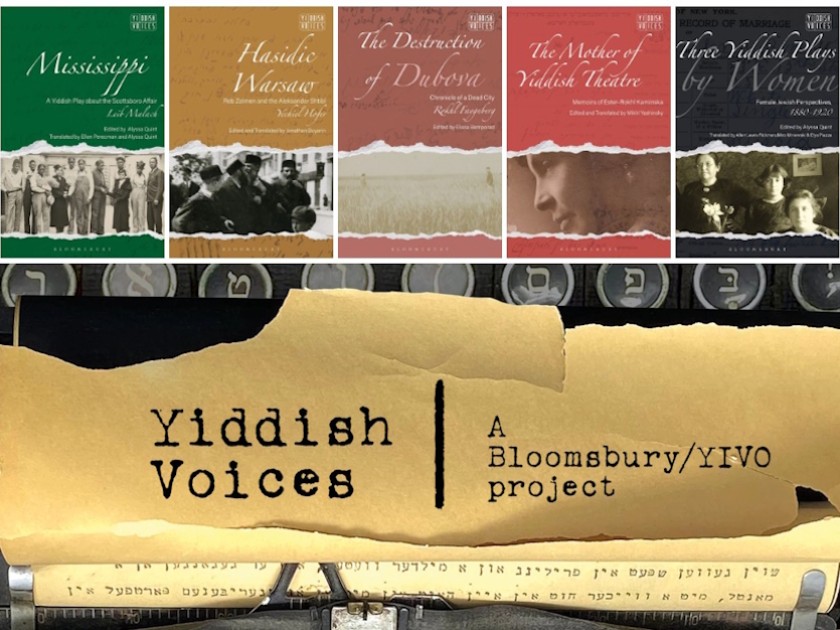
A question we often receive about our new translation series, Yiddish Voices, is: how do you choose what to publish?
Launched in 2023, Yiddish Voices is copublished by YIVO and Bloomsbury Academic. And our mandate is broad with two essential tenets: we publish works having to do with the Eastern European Jewish experience, mostly in Yiddish (we do have works, for example, in Hebrew and Polish in the pipeline) and ones with rich historical aspects to them. Each volume we publish begins with an introduction in which a terrific scholar frames the text and unpacks these aspects. Every volume of Yiddish Voices is meant for both the classroom and general reader. We publish treasures that promise vivid and unique angles into the multilayered cultural life of Eastern European Jewry. Within this scope resides such a huge number of fabulous reads as of yet unknown to the English reader that these guidelines are almost no help at all!
We began by jumping through the hoops of peer-reviewing the series with texts we had already discovered through our own research, works we knew well and felt commanded a broader audience. For Alyssa, an expert on the modern Yiddish theater, it was Three Plays by Women (volume 1) and the memoirs of Esther Rokhl Kaminska (volume 2 of Yiddish Voices), the most important actress on the Yiddish stage. These marvels dispel any preconceptions a reader may have about Yiddish theater as folksy and pious. In these volumes we traverse themes of prostitution, abortion, motherhood, and mental illness. Coming out this year in our series is a third theater related text that is equally startling:Mississippi: A Yiddish Play about the Scottsboro Affair, that was written and performed in Warsaw in 1935.The Scottsboro Affair began when nine Black youths were falsely accused of raping two white women in 1931 in Scottsboro, Alabama. Now translated into English for the first time by Alyssa Quint and Ellen Perecman, we are very pleased to bring this important work to new audiences. Please join us for the launch of Mississippi and Hasidic Warsaw on November 30!
For Elissa, a must for the series was Rokhl Faygnberg’s The Destruction of Dubova, a haunting, meticulously documented account of the life and death of one Ukrainian shtetl during the turbulent years of the Russian Civil War. As an expert on anti-Jewish violence and gender in modern history, Elissa was drawn not only to the profound human dimension Faygnberg captures, but also to the significance of the author herself: Faygnberg was one of the first professional Jewish woman writers to earn her living through novels and essays published in the Yiddish and Hebrew press.
Once the series was greenlit by Bloomsbury based on these proposed volumes, and YIVO provided us with funding, we hung out our shingle. And then came the submissions.
If you hear the drum of typing after you turn in for the night, it might be the sound of translators of Yiddish texts translating Yiddish works after returning from their day jobs. Yiddish translators translate, with no certainty that what they produce will be published. They do it for the joy of engaging with the Yiddish language. One such example is the Yiddish language instructor Miriam Isaacs, who took on the memoirs of the Yiddish Israeli comedian Shimen Dzigen. The volume is forthcoming from Yiddish Voices under the title: A Yiddish Comedian’s Guide to Surviving Hitler and Stalin. Who could have predicted a comedian could pen such a thrilling read? His memoir is by turns harrowing and hilarious and stretches through time from Interwar Poland to the decades after the declaration of the State of Israel.
The most recent volume of Yiddish Voices, Hasidic Warsaw: Reb Zalmen and the Aleksander Shtibl, is a collection of short stories by the brilliant Yiddish storyteller Yechiel Hofer. The renowned scholar Jonathan Boyarin brings Hofer’s intimate portrait of early twentieth century prewar-Warsaw to life: a world made of Hasidic courts, petty rivalries, poverty, and deepening doubts about modernity.
Besides the forthcoming volume by Dzigen is a searing novel, Women of the Ghetto (2027) by the legendary Yiddish writer Chaim Grade whose archival collection resides at YIVO. The historian Dovid Fishman pieced together a beautiful Grade novel from the serialized segments of a yellowed Yiddish newspaper that Grade himself likely collected for posterity. There is a breathless quality to the narration that describes a community of secular Jewish women, survivors of World War II, who try to rebuild their lives facet by facet, as bread-earners, mothers, daughters and lovers. Virtually unknown and also a masterpiece, Women of the Ghetto juxtaposes their rich interior lives with the austere city of post-war Vilnius.
And then there is our sponsor: the YIVO Institute for Jewish Research located here on 16th street in New York City. As both of us have rolled up our sleeves in its archives many dozens of times, we know how many thousands of fascinating documents would lend themselves well to our series. Yes, thousands. One forthcoming titles come to us via YIVO and the scholars that have raked through the contents of some of their most important collections. The historian Glenn Dynner is busy on a forthcoming volume that introduces us to the autobiography of a turn-of-the-century Hasidic woman, Jula Wald, living in a traditional world rocked by the forces of modernity. The autobiography of Wald covers it all: suitors, books, love, religion, business and war and, of course, inter-generational conflict.
YIVO-Bloomsbury’s Yiddish Voices is still in its infancy (and, ahem, a not-for-profit enterprise). We want you to be part of our community of readers. Follow YIVO on Instagram to hear about our latest projects; come to our free and freylekh (i.e. open-bar) launches at YIVO (which can also be watched via Zoom); include us in your book club choices (we’d be happy to make an appearance); and buy our books, preferably from YIVO’s online bookshop where you can get 20% off with the code YIDDISHVOICES.
Alyssa Quint, co-editor of Yiddish Voices, is an associate editor at Tablet Magazine and a Leon Charney fellow at Yeshiva University. and Associate Editor. She is the author of The Rise of the Modern Yiddish Theater (2019), a finalist for the National Jewish Book Award and a finalist for the Jordan Schnitzer Award. She is also the editor of Women on the Yiddish Stage, Three Yiddish Plays by Women, and Mississippi: a Yiddish Play about the Scottsboro Affair. She is also a contributing editor of the online Digital Yiddish Theater Project.
Elissa Bemporad is Professor of History and Ungar Chair in East European Jewish History and the Holocaust at Queens College and CUNY Graduate Center. She is a three-time winner of the National Jewish Book Award. She is the author of Becoming Soviet Jews: The Bolshevik Experiment in Minsk (Indiana University Press, 2013), Legacy of Blood: Jews, Pogroms, and Ritual Murder in the Lands of the Soviets (Oxford University Press, 2019), and Revolution, Civil War, and New Ways of Life (NYU Press, 2025). She is the co-editor of four volumes, including Women and Genocide: Survivors, Victims, Perpetrators (Indiana University Press, 2018) and, together with Eugene Avrutin, Pogroms: A Documentary History (Oxford University Press, 2021). She is currently working on a biography of the socialist-turned-communist Ester Frumkin. She is Series Editor of Yiddish Voices for Bloomsbury Academic/YIVO.