Join a community of readers who are committed to Jewish stories
Sign up for JBC’s Nu Reads, a curated selection of Jewish books delivered straight to your door!
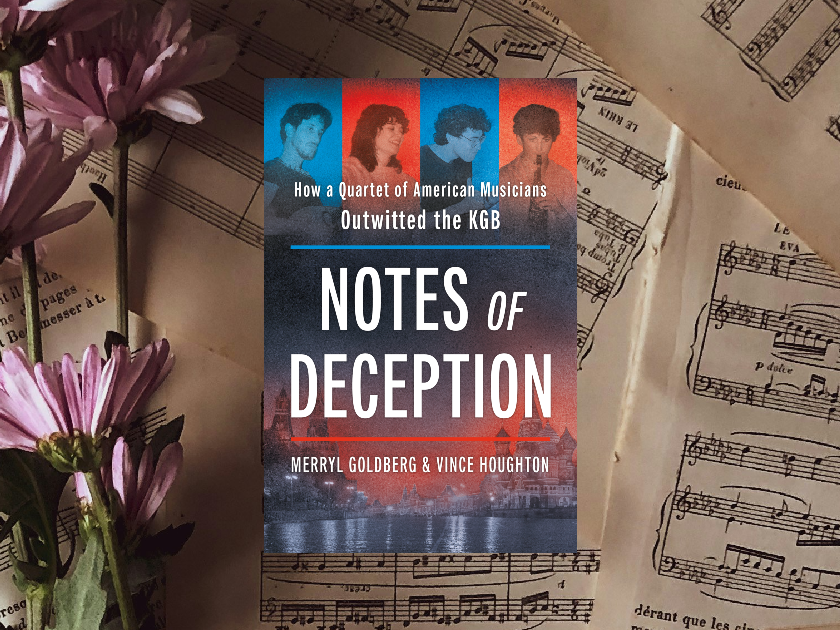
Notes of Deception: How a Quartet of American Musicians Outwitted the KGB chronicles the incredible story of how a klezmer band used a musical cipher to smuggle vital information out of the Soviet Union. Four musicians extracted crucial information to help Refuseniks immigrate and to bring their stories to Western audiences. Merryl Goldberg and Vince Houghton’s new book illuminates this daring story. Goldberg is the cipher-creator and saxophonist in this 1980s band and Houghton is a historian and espionage expert. The two spoke about how this book came to be, the wide-ranging implications of Goldberg’s efforts, and more.
Vince Houghton: You and your three Klezmer bandmates entered Moscow in 1985 with a plan to smuggle secret information out of the country under the watchful eye of the KGB. You were musicians and untrained spies.
What was the impetus for you to share your story more than forty years later?
Merryl Goldberg: It was a bit of a fluke. I was at a party and met two cybersecurity experts, and I ended up telling them my story. They were flabbergasted to say the least! They said I would become famous — which I didn’t believe — but within a few months I was asked to be a keynote at the RSAC™ conference, the biggest cybersecurity conference on Earth. While attending the conference, I was noticed by Jen Easterly, Director of the Cybersecurity and Infrastructure Security Agency (CISA), and a huge deal in the industry. I had a huge learning curve on cybersecurity, ahead of me, which I dove into headfirst!
Vince, how did you first hear about the story of the four American Jewish musicians turned-amateur spies? What was your initial reaction?

Photo credit: California State University San Marcos
VH: Some colleagues returning from the RSAC™ conference mentioned the tale to me. I assumed it was fiction, because it was totally unbelievable. Then I read the story in WIRED and realized it was true. My mind was blown.
MG: Given your experience in counter-intelligence and working with the National Security Agency, you’ve been privy to many remarkable stories of espionage. What is it about this mission that hooked you and then led you to help me tell this story?
VH: This story, more than just about any other I’ve encountered, was relatable to the average person. There are dozens and dozens of amazing spy stories out there, but they are almost all told from the perspective of some intelligence professional with years and years of training. This story is different. It could have been anyone.
JBC Staff: How did you two connect?
MG: Vince was told about me after my keynote at RSAC™ and could hardly believe it. He looked up my story and sure enough found out it wasn’t a made-up wild story by some wannabe adventure seeking nutso. Curiosity sparked; he reached out to me, and I happily connected with him, with equal curiosity! I was a bit dumbfounded that so many people were interested in the story. I started making the connection, however, that creating codes was a huge aspect of cybersecurity (and spying!).
VH: Exactly as Merryl mentions — I cold emailed her and told her I’d love to talk to her about her story.
During your visit to Moscow as well as other cities in the Soviet Union, you were able to meet with many Jews and smuggle out important information regarding their political and social circumstances. Can you briefly explain the immediate reactions and actions that resulted from your trip and the materials obtained?
MG: First off, our visits brought in joy, information, and gifts to the Refusneiks — something that would encourage them to continue their own efforts. Secondly, the information we brought out of the Soviet Union was crucial for the future of the Refuseniks. For example, bringing out names and addresses meant new families could be sent invitations by the US government and then begin the process of applying for an exit visa. Equally important was the information shared with the West that would provide a certain amount of protection and visibility for the Refuseniks looking to immigrate. Additionally, we were super lucky being from Boston, because Ted Kennedy was our senator and he had a huge role in the Regan/Gorbachev summits. Keeping the accounts of the Refuseniks as a priority helped bring attention to them at the summits.
From your perspective as an historian and espionage expert, can you briefly explain the importance of the information me and my bandmates were able to secure, as well as how we were able to obtain it?
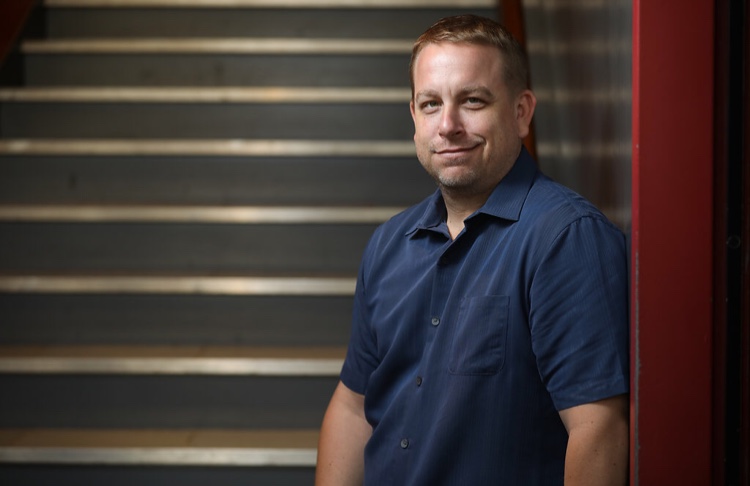
Photo credit: International Spy Museum
VH: As far as we can tell (and the “we” here is everyone who studies this for a living), no one has ever used a musical cipher in an “operational” sense before. They’ve been discussed over the last several centuries, but mostly as something fun or interesting someone one day might try, but that’s about it. Your cipher allowed the band to bring out information the Soviet government really didn’t want to get out. The KGB had previously been very effective at preventing this kind of information from leaving. But they never anticipated people using music as a cipher.
The information brought out was incredibly important. It allowed for people to send invitations to the Refuseniks (needed in order to have a chance to get a visa). But perhaps more importantly, it allowed for the Refuseniks’ stories to be publicized in the West, bringing much-needed attention to their plights, and providing powerful people (i.e., Ted Kennedy) with the information they needed to make a difference.
JBC Staff: What do you hope people take away from their reading of Notes of Deception?
MG: There’s a parable a friend shared with me about a boy on a beach where he came upon thousands and thousands of starfish that had been beached. The little boy starts throwing them back one by one. A man comes by and asks in disbelief, “What are you doing? There’s no way to make a difference and change this situation. There’s way too many starfish.” The little boy turns away and picks up another starfish and throws it back into the ocean. He says to the man, “It matters to this starfish.” Acts, no matter how small or inconsequential they may seem, make a huge difference.
VH: I think Merryl’s response to this is dead on. The only thing to add is what I mentioned earlier: This is a story in which we see four extremely regular people do extraordinary things. And they do them in a way in which we can all relate.
Dr. Vince Houghton is Director of the National Security Agency’s National Cryptologic Museum. He is the former Historian and Curator of the International Spy Museum in Washington, DC. Vince has a PhD in Diplomatic and Military History from the University of Maryland, where his research centered on US scientific and technological intelligence (nuclear intelligence) in the Second World War and early Cold War. His Master’s degree, also from the University of Maryland, focused on the foreign policies of the United States and the Soviet Union. He has taught extensively at the middle school, high school, and university levels, most recently at the University of Maryland, where he lectured on the History of US Intelligence, US Diplomatic History, the Cold War, and the History of Science. He is also a veteran of the United States Army, and served in the Balkans, where he worked closely with both civilian and military intelligence agencies in several capacities. Dr. Houghton is the author of three books: Nuking the Moon: And Other Intelligence Plots and Military Schemes Left on the Drawing Board (Penguin, 2019); The Nuclear Spies: America’s Atomic Intelligence Program Against Hitler and Stalin (Cornell University Press, 2019); and Covert City: The Cold War and the Making of Miami (Public Affairs, 2024).