Join a community of readers who are committed to Jewish stories
Sign up for JBC’s Nu Reads, a curated selection of Jewish books delivered straight to your door!
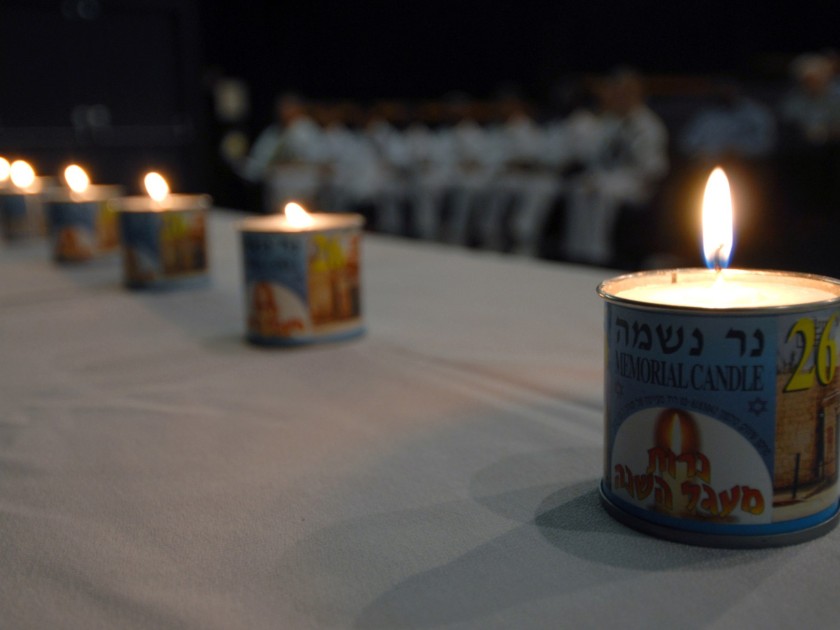
Photo by James E. Foeh for the US Navy, via WikiMedia Commons
As I entered the room where my wife’s family was sitting shiva for her brother, I was startled by a completely unexpected sound.
Laughter.
Only days removed from the funeral, we were all still reeling from David’s death. The scant passage of time had done little to blunt the pain. Yet there were my in-laws, smiling through tears as they sat on low chairs in a crowded house, surrounded by neighbors and friends. Someone had just shared a well-worn story of boyhood shenanigans — with David playing a starring role, of course — and the memory was a beacon that guided us to happier times.
“Because sadness and joy can be together, like a candle in the dark.”
Years later, I wrote this line while thinking back on that impactful moment. The threads for what would eventually become my children’s book A Flame Burns On were beginning to coalesce in my mind, and they all centered on this seemingly contradictory idea of laughter in the midst of mourning. For me, those sparks of remembered joy during the seven days of shiva were essential for the healing process. And over time, I came to realize that the light of memory does not dim, just as our love for the deceased does not fade.
That’s what I find so powerful about the yearly ritual of lighting a yahrzeit candle on the anniversary of a loved one’s passing in the Hebrew calendar. On the day we commemorate the loss, we also rekindle our connection to the lost. The steady flame of the candle is a comforting reminder that the people we love continue to touch our lives, long after their physical departure from this world. For my wife, the candle illuminates cherished moments collected over a lifetime of shared sibling experiences. And for our children, the candle is a perpetual invitation to ask for “just one more story!” about their legendary Uncle David.
On the day we commemorate the loss, we also rekindle our connection to the lost. The steady flame of the candle is a comforting reminder that the people we love continue to touch our lives, long after their physical departure from this world.
In a broader sense, I feel strongly that there can always be more stories — particularly in the realm of picture books on the subject of grief. Death and mourning can be difficult topics for readers of any age, let alone the youngest. The scarcity of such stories in the children’s sections of bookstores and libraries reflects an antiquated belief that books for kids should not be sad, because tragedy is too much for them to handle. I saw firsthand the negative consequences of this approach, when I searched for books to help my son process the loss of his uncle but came up empty.
Thankfully, conventional wisdom is changing. In recent years, picture books that address universal life events such as the loss of a family member have become far more common. Jewish publishing especially has seen a proliferation of these books, many of which shed light on time-honored traditions of remembrance within Judaism. This year alone, readers will be able to learn about sitting shiva in Something Sweet by Lesléa Newman and Sarita Rich, an unveiling ceremony in I Wish That You Knew by Rebecca Gardyn Levington and Alyssa Russell, and a yahrzeit candle in A Flame Burns On by me and Carmel Ben Ami. And this follows last year’s release of The Remembering Candle, another wonderful yahrzeit candle book by Alison Goldberg and Selina Alko.
In a publishing environment that is challenging (to say the least) for Jewish stories of any kind, the fact that we’ve seen gains in this small but vital niche is a cause for celebration. By creating stories to help children process the realities of life, authors and illustrators like those listed above are doing their best to fan the flames of empathy, community, and resilience in the world.
As the publication of A Flame Burns On approaches, I feel grateful for the opportunity to transform my memories of my brother-in-law into a story for a wider audience. It is yet another example of how David’s legacy continues to bring light to those around him. For while the idea of writing this book was partly motivated by the need to fill a space on the proverbial bookshelf, in truth it was borne from the same impulse symbolized by the very act of lighting a yahrzeit candle.
To keep a person’s memory alive.
Richard Ho is the acclaimed author of many picture books, including The Lost Package, illustrated by Jessica Lanan, which received four starred reviews, and Two New Years, illustrated by Lynn Scurfield, which was a Sydney Taylor Gold Medalist and a National Jewish Book Award Winner. He lives with his family in New Jersey.