Join a community of readers who are committed to Jewish stories
Sign up for JBC’s Nu Reads, a curated selection of Jewish books delivered straight to your door!
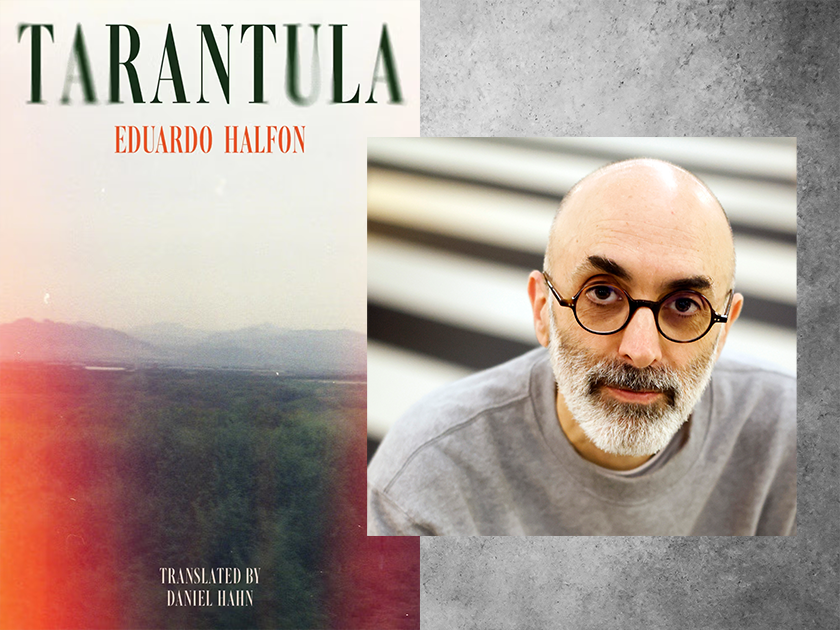
Author photo by David Herranz
Daniel Turtel spoke with acclaimed author Eduardo Halfon about his new novel, Tarantula, a haunting examination of memory, the Holocaust, and legacies passed down. The book straddles countries and decades, with formative experiences in a 1980s Jewish summer camp in Guatemala that propel the story forward.
Daniel Turtel: I think it’s important for readers who may not be familiar with your work to understand the distinction between Eduardo Halfon the writer and Eduardo Halfon the character. Like your other work, Tarantula is fiction. Has Eduardo Halfon the character taken on a life of his own, and are there any differences between the two?
Eduardo Halfon: Yes, there are stark differences between the two. Eduardo the character was born in The Polish Boxer. That’s 2008 for the Spanish edition of the book. He just arrived there when I started writing those stories — with his own voice, which is not mine. With his own temperament, which is also not mine. As you know, he smokes a lot, and I do not. He travels — he travels better than I do. He says things that I would not have the courage to say, perhaps. And he’s also openly lost. He doesn’t know. He doubts. I tend to be much more rational than that. Very engineer-like. He has taken on a life of his own. And I just follow.
DT: A reporter poses the question: what are the books you’ve never read that have had the greatest influence on you as a writer? This seems to underscore the tension at Tarantula’s heart — between what can be inherited, and what must be personally experienced. Is that a question you’ve been asked? Would Eduardo Halfon the writer have the same answer as Eduardo Halfon the character?
EH: This is a great question because it does go to the heart of the matter. What can be inherited and what must be personally experienced? I’ve wrestled with this because what you’re really asking is what makes up our identity. Do we inherit who we are — the family we’re born into, the country we’re born in? Is that all already in the model? Or do we acquire parts of our identity — the languages we learn, the places we live in, the things we do or don’t do? My learning English and moving to the US must have affected who I am. My becoming a father nine years ago undoubtedly affected who I am. So I believe it’s both. I believe there are things that we inherit from our grandparents and great grandparents, but I also believe there are traits or pieces of identity that are acquired along the way. In the beginning of my novel Canción (2021), that other Eduardo Halfon is invited as a Lebanese writer to Tokyo, and he goes. He puts on his costume, his Lebanese disguise, and he arrives — as he says — dressed as an Arab. He is playing the part that he inherited from his Lebanese grandfather. So the question within the question is this — if we play the part long enough, do we become it? If I pretend to be something, if I role play something long enough, does that become part of who I am, part of my identity?
DT: Speaking of things that need to be experienced — that summer camp. Of all the shocking things about it, I was particularly struck by the notion that parents actually send their children there. We can probably assume (because we learn that a lawsuit was filed) that what happened was not explicitly on the brochure. And yet, we don’t know what was on the brochure, and this point remains open because we never see Eduardo confront his parents about sending him there. What did they think was going to happen?
EH: This type of camp is called a Machane or Machon in Hebrew. They were very popular throughout Latin America, and I have been to several. They’re like the boy scouts — earning how to build a fire, walking in the woods, and playing with your friends. They’re fun when you’re young. And the ones I had been to before this one — because the one in the novel is based on a personal experience — had all been fun. But this one turned dark. This one is an extreme example of one approach to teaching children. And so, no, that wasn’t in any of the brochures. My parents were scandalized. Neither of them knew that was going to happen. And what’s interesting now is how many emails I have gotten since publishing the book almost two years ago in Spanish, French, Hebrew, amongst other languages, of people who went through the same experience as Jewish children growing up in the 1980s. So this seemed to be a relatively common practice back then: that is, a recreation and a reenactment of a concentration camp as a teaching device. Using theater to teach children. You have re-enactments all the time of the Civil War, for example. In this case, the reenactment was taken very seriously and we were forced to participate.
DT: The character of Samuel plays the role of knowing villain in this simulation, but shows no remorse when confronted about his actions. He presents the case for the camp’s necessity clearly and compellingly, arguing for the ethics of simulating horror. While the adult Eduardo character does not hide his disgust, he stops short of expressing that Sam is flat-out wrong. Can you talk about the decision not to refute that position, and the value of posing questions without answering them?
EH: For me, it was very important, when writing the book, to give Samuel Blum the opportunity to explain himself. Why did he do this? And I think he does, as you say, make a compelling case. You can, in theory, understand how using reenactment or theater as a didactic exercise can be effective. I remember when I arrived in the US, in the early 1980s, I had a teacher in middle school who had us memorize the testimonials of slaves and then act them out. It’s using theater, using reenactment, to understand the part you’re playing. And in the book, I’m very careful to be objective. I’m letting him speak. I’m putting the microphone in front of him and letting him explain himself. But you can sense what that narrator is feeling without him having to say it. And that was important. That it was not a condemnation. There are more questions at the end than answers, I believe, because that’s the way literature works. I am not here to tell you what I think or what I believe, but to present the story for you to make up your own mind and for you to answer those questions for yourself. Is he right? Is he wrong in doing this? That is not for me to say.
DH: Samuel rejects Eduardo’s memory of a Nazi flag being hoisted, and given how honest he is about the other aspects of the camp, we don’t have real reason to distrust him. The implication is that Eduardo’s memory — no matter how salient to him — may also be up for inspection. It struck me as a reader that this is both a very important, but also a completely avoidable point (it occupies about one paragraph). Can you talk a bit about how this ties into a novel which is very much about the inheritance of victimhood.
EH: I’ve always been fascinated with the almost contradictory aspect of memory. Of memory as something vital, something we need, something we cherish and protect, but also — at the same time — incredibly fallible. It’s untrustworthy. And that is what’s happening here. Not only with Eduardo’s memory, with Eduardo’s father’s memory — with that sign in front of the golf course. Both of these examples — and there are others, not only in Tarantula, but in my other books — speak to the unscientific aspect of memory. It is something that we create, that we change and edit and manipulate. Another example: when I was writing, I contacted many of the kids who went through this experience with me, and each of their responses was radically different. Everyone remembered the same event differently. One of them answered, ’What are you talking about? That never happened.’ And my only answer, my only possible explanation to that, is that he blocked it out. I also spoke to my brother, who remembered things differently. He remembered things that I had forgotten. So memory is wonderful for fiction.
I’ve always been fascinated with the almost contradictory aspect of memory. Of memory as something vital, something we need, something we cherish and protect, but also — at the same time — incredibly fallible. It’s untrustworthy.
DH: Samuel’s honesty points to the idea that a lot of wrong is done with the best of intentions, and that perhaps we ought to fear zealotry more than pure evil. In particular, this novel is set in two places — Guatemala and Berlin — which have historically experienced great evil in the name of the greater good. Eduardo’s answer in Guatemala is to run, and in Berlin it is to remain relatively silent while Sam makes his case. Is Eduardo’s resistance to fighting back a recognition of his own uncertainty as to whether or not he is right, or is it more of a decision to avoid reactive zealotry?
ED: I think my reaction to these evils that I inherited — the Guatemalan genocide of the indigenous Mayan people, and the Holocaust — is to write about them. And my character of Eduardo reacts the same. In my writing, in my desire to get closer to what happened, I keep returning to the Guatemala of the 1970s and 1980s. And the same goes for Berlin. Perhaps that’s why I’m still here. We live in Wannsee — a red flag for all Jews — about a kilometer or two from where the famous Nazi conference took place. Which means I live on the outskirts of Berlin. I’m not really in Berlin, but Berlin is in me, in a way. My grandfather spent the most time in concentration camps right here, in Sachsenhausen, just outside of Berlin. I’m almost returning to the place where he was imprisoned through my writing.
DH: In Eduardo’s present-day conversation with Regina, the girl he met at the summer camp, we learn that one thing that Eduardo does experience is the more subtle antisemitism of being renamed “Israel” by his German Guatemalan classmates, while the Jewish girls were called “Sara” —a reincarnation of 1938’s Law on the Alteration of Family and Personal Names. “An entire people reduced to two names,” as you so aptly write in the novel. Can you talk about the differences in reducing oneself to two books and an oppressor reducing you to two names? It’s an interesting parallel.
EH: I had never noticed that — two names and two books. It was not a conscious thing — most things when writing are not — but there is definitely an interesting parallel there. The Germans reduced the Jews with this 1938 law to two names, which is basically a way of removing certain parts of their identity. It’s a different way to number them, to remove the humanity from the Jews. In my case, it’s just a metaphor, these two books that I haven’t read but that have influenced me the most. I guess it’s also a way of making it simpler to understand. There are these two big pillars upon which I am built. The Jewish pillar and the Guatemalan one, represented in this case by the Torah and the Popol Vuh. Which is an overexaggeration, a hyperbole, perhaps, but it makes the image very clear.
DH: You’ve been compared to Roberto Bolaño, and the comparison is clear. One big difference — in Tarantula, at least — is that the violence here is play-violence, even if it doesn’t feel like it to the children. For a novel that covers what Tarantula covers, it is surprisingly quiet, and a lot of work is done off the page. Even Regina’s horrifying backstory — as told by her — avoids the actual moment that her head is shaved, preferring the perspective of her mother. Can you talk about the advantages and disadvantages to this more subtle form of violence?
EH: This is the way Guatemalans live. We live with the promise of violence, with the fear of violence, all the time. You’re about to be kidnapped, you’re about to be shot, you’re about to be held up at gunpoint. It’s everpresent in daily life. Usually, if you’re lucky, it never arrives. But you’re just as immersed in this mesh of violence, which is almost worse. The fear of violence is almost worse than the violence itself. And I tend to replicate this in all of my books — the violence, although always present, never arrives. There is a suspense generated by the fear of violence, which makes it stronger for the reader. The tension that is generated by not stating it. By not showing it. Just hinting at or alluding to a violent outcome makes it much more violent.
DH: Finally, it’d be hard not to notice that the hatreds which dominate this book are more noticeable today than they were even a few years ago. Is hatred — like trauma — something which is inevitably passed down?
EH: I don’t know if hatred is passed down, but it definitely is learned. You can teach people to hate. You can teach people to hate those who aren’t like you. And you can also teach to love and respect those who aren’t like you. I think it depends on us, doesn’t it? Which teaching are we going to pass down to our children?
Daniel H. Turtel is the author of the novels The Family Morfawitz and Greetings from Asbury Park, winner of the Faulkner Society Award for Best Novel. He graduated from Duke University with a degree in mathematics and received an MFA from the New School. He now lives in New York City. Follow him on X at @DanielTurtel.