Join a community of readers who are committed to Jewish stories
Sign up for JBC’s Nu Reads, a curated selection of Jewish books delivered straight to your door!
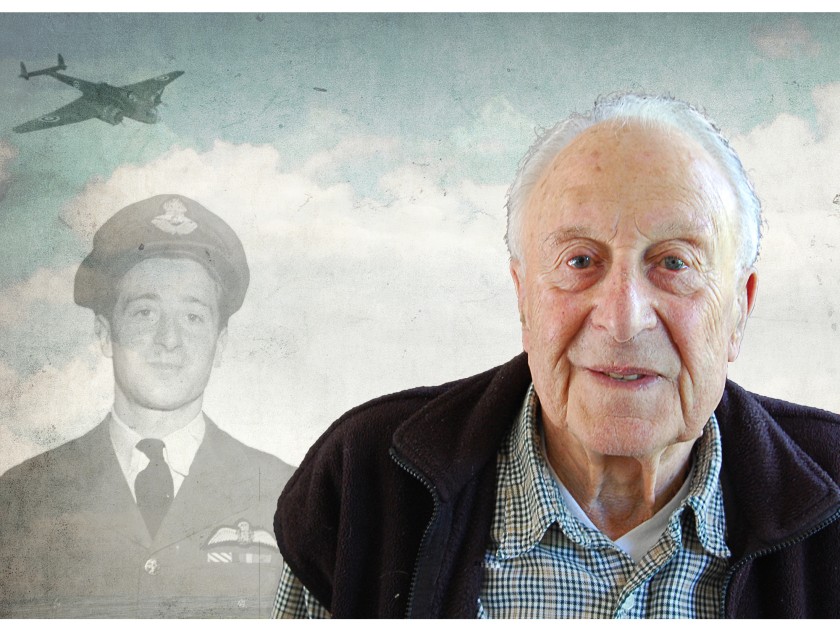
Alfred Brenner in 1943 and 2010. (Courtesy of Historica Canada, https://www.historicacanada.ca/.)
When people think about the Jewish experience in World War II, there’s only one thing that immediately comes to mind: the Holocaust.
But there is another side to the story, that of the 1.5 million Jewish soldiers who fought for the allies in World War II, of which more than 250,000 died in battle, and this narrative has largely remained untold.
Aside from my historical interest in this topic, I’ve also had personal motivation in pursuing the story.
My grandfather, Mickey Heller, served four years in the Royal Canadian Air Force, including two years in Europe as a navigator in Bomber Command. But that’s all I, or anyone else in my family, knew. I had hoped that my exploring the larger contribution of Jewish soldiers like him would help shed light on his own murky military past.
Knowing how my Zaidy had always been more forthcoming about the stories of others, I decided to engage him in my research and fired off occasional emails informing him of my findings. Some of this material included a link to a collection of comic-like brochures that the Canadian Jewish Congress issued in 1944 seeking to highlight the “Jewish War Heroes.”
The “hero” that most caught my attention was Flying Officer Alfred Brenner, a Canadian pilot who was credited with destroying a 5,000-ton German merchant ship on February 18, 1943, near the Frisian Islands, located off the coast of the Netherlands.
“We got that one, Alf. She’s sinking,” read the dialogue in the comic.
“Yes. And they got us too,” Brenner replied. “Can’t keep her up much longer.”
I figured Zaidy may find the comic strip entertaining. Little did I know that he and Brenner shared a connection that ran much deeper.
______
On February 18, 1943, Brenner’s three-man crew were on a sortie off the Dutch coast when they came across a convoy of twelve Nazi merchant ships accompanied by five destroyers.
Brenner and his crew zeroed in on one of these prime targets. He plunged till he was almost at water level and then dropped his torpedoes. It was a direct hit and the merchant ship burst into flames. Then came the return fire.
“All hell broke loose. Every ship in the convoy began firing at us,” Brenner later told the Canadian Press.
Brenner had taken out the freighter, but his own Hampden bomber was shot up so badly that he would have to crash land.
The Hampden was known as the “flying suitcase” because of its cramped cockpit, and it was considered one of the more dangerous World War II planes to fly. In fact, by 1942, it had already been removed from most war theaters because of its hazardous reputation.
Brenner’s plane was badly damaged. The rudder, the port engine and the wing tips had been hit by the flak from the Nazi destroyers. Brenner also felt an immense flash of heat from a shell that penetrated the fuselage through the bomb bays, striking the armor behind his pilot seat.
Brenner climbed up to 2,000 feet, from which point the radio operator was able to send an SOS, before Brenner descended and settled the bomber into the cold waters of the North Sea, thirty miles from Great Yarmouth in England.
The plane sank quickly. But before it did, the crew members were able to inflate a rescue dinghy and escape. However, paddles, flares, sailing masts, and rations went down with the aircraft.
Brenner and his crew used their now-useless flashlights, with dead batteries removed, to bail water from the dinghy as they floated in dangerous waters. Miraculously, one crew member had managed to save the pigeon container, and the pigeons were dispatched back to Bomber Command with coordinates.
Not knowing their fate, the crew members held off from drinking their only fresh quart of water. For meals, they allowed themselves one energy tablet from a first aid kit that they had managed to salvage.
Two days later, they were spotted by a rescue unit and were picked up near the English coast after drifting for forty-three hours in the North Sea.
The rescue plane skimmed into the water after dropping a smoke flare to guide its way and Brenner and his crewmates were able to grab the rescue float as all the men were pulled on board.
The captain of the rescue flight reported that the men were surprisingly well after such long exposure to the elements. And despite not having had any water in two days, the three men seemed mostly interested in confirming that the merchant ship they’d torpedoed was a confirmed hit.
For these exploits, Brenner was honored with the Distinguished Flying Cross. King George VI presented the award to him on September 10, 1943, at Buckingham Palace.
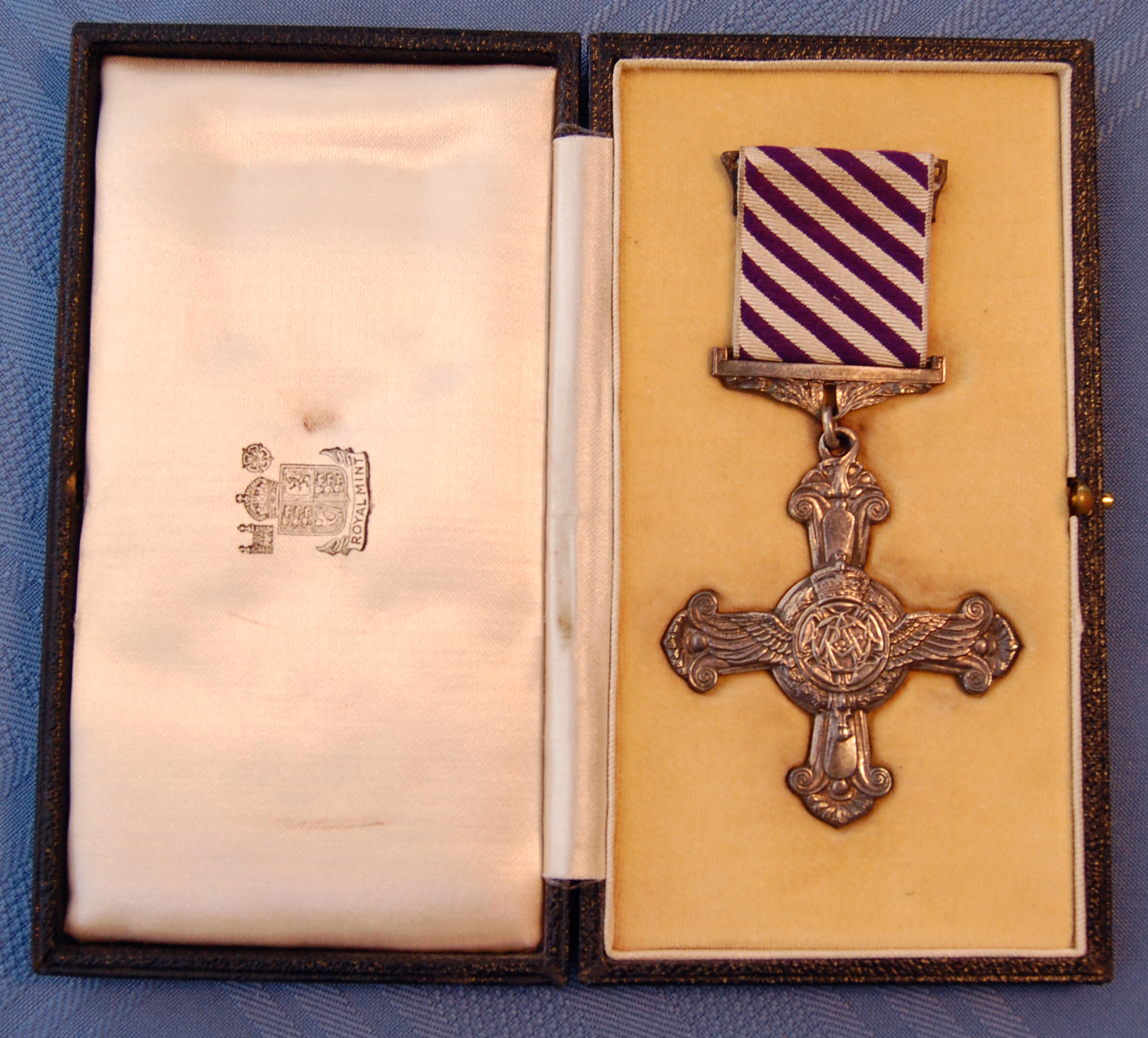
Alfred Brenner’s Distinguished Flying Cross. (Courtesy of Historica Canada, https://www.historicacanada.ca/.)
The dispatch to the medal read in part: “Throughout his [Brenner’s] tour of operations, this officer has displayed the greatest keenness and devotion to duty.”
Brenner was one of nearly 200 Canadian Jewish servicemen who were decorated for heroism in battle. His actions were deemed so heroic that, in 2020, then-Canadian Prime Minister Justin Trudeau chose to highlight them at the start of his address to parliament marking the beginning of Veterans’ Week.
“In the face of danger, Alfred and his crew chose to be brave,” Trudeau said. “They chose to put their own lives on the line for the greater good.”
______
Responding to my detailed report, Zaidy wrote back and casually informed me that Brenner was, in fact, his second cousin.
“Our grandmothers were sisters. But he was from a well-to-do family and went to a private school, so they gave me his hand-me-downs,” Zaidy said. “He was older than me and I used to get his grown-out clothes. All I ever wanted was a sweater, but we didn’t have any money, and I never had one. The private school he went to did not allow sweaters, only suits. So that’s how I ended up being the best-dressed kid in my school wearing a three-piece suit.”
The happenstance made me wonder what other kinds of colorful nuggets like these Zaidy had stashed away from those days. What more was there to discover?
It was another reminder of how Zaidy may not have been a primary actor in the war theater, but he was a bit player on the set. Like the title of Jerzy Kosiński’s famous novel, Zaidy’s significance seemed to be merely “being there.” Or, to use another literary analogy, I never thought he would be the “Great Gatsby,” but I still hoped he could be the Nick Carraway who introduced the heroes of our story.
Aron Heller is a reporter, writer, and broadcaster. He focuses on technology storytelling and podcasting, and was previously a longtime Associated Press correspondent and journalism lecturer. He has covered ten Israeli elections, four Mideast wars, and dozens of other major world events across five continents.