Join a community of readers who are committed to Jewish stories
Sign up for JBC’s Nu Reads, a curated selection of Jewish books delivered straight to your door!
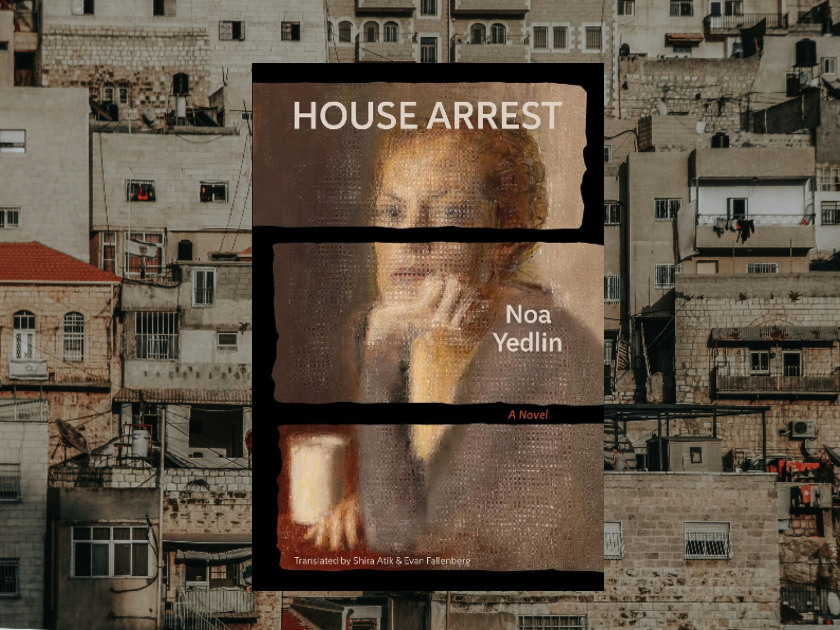
From the outside, the house looked the same as always: imposing, self-confident, shamelessly claiming its share from a city that’s not big on giving. He looked for signs of change, but he found them only in the neighbors’ houses, which seemed to be shooting contemptuous glances at his parents’ house. The house on the right, 9 Elharizi, which had always been taller than Ben-Ami and Elisheva’s, now appeared to be gloating, holding itself aloft as if it had rightfully earned its stature. The house on the left, number 5, seemed to be flaunting its piousness, as if it was finally proving itself to its more glamorous neighbor.
For the first time in his life, Barak wished that his childhood home could camouflage itself, could bow its head and be absorbed into the quaint little street. But the street was so narrow that living there felt like a tremendous achievement, as if someone had hand-picked all the residents, and each house was so unique, so proud, that the very notion that it might feel ashamed of itself was inconceivable.
The houses were marked by good taste; instead of broadcasting their value from their front porches, they wore their worth with discretion, almost with modesty. The street was also fortunate enough to be spared the fate of other charming little streets, which had been overtaken by new residents for whom money wasn’t simply a pleasant soundtrack playing in the background but an ideology, and all it took was one such owner to ruin an entire street, especially in a city like Jerusalem.
The house was filled with light, which always surprised people when they came in from the Jerusalem fog, and which gracefully highlighted the contents of the house: the artwork in the living room (Rauschenberg, de Kooning) that Elisheva had insisted on renting from the museum even though she served on the board of directors and could have borrowed the paintings for free; the sofas and armchairs, the piano, the rugs — all old without being out of date. During the day, when the family was home alone, the furnishings shimmered in the bright, boastful light; as evening approached, and the danger of guests increased, the light grew weaker and the objects became more refined, cloaking their uniqueness in a veil of modesty befitting a house owned by refined people.
Now the house was dark, striking Barak, momentarily, as almost abandoned: outside of his imagination, there was no sign of the four, or maybe five, police officers — Barak had tried to count them several times, as if he was playing a computer game, trying to distinguish them despite their identical uniforms and their similar silhouettes, in an attempt to distract himself from the real issue, and, he later realized, to memorize their faces so that someday he could shoot them withering looks — walking up and down the short path to their house, carrying box after box like the cops on those TV shows that had been airing in reruns forever.
Then he tried to picture his mother’s office, and all the papers scattered around her house, everything that could qualify as “evidence,” as in, “The police are gathering evidence from the home of Elisheva Fogel,” and all of a sudden it seemed to him that there wasn’t a single piece of paper left in the entire house. He thought about his own house, about where all his papers could be found, charting a map in his mind, following an imaginary trail that led him to the message pad next to the telephone and to a huge pile of neglected pension statements and utility bills on the bookshelf in the foyer. But when he thought about his parents’ house, all he managed to dredge up was a single pathetic piece of paper on the refrigerator door, maybe an invitation to the grandchildren’s kindergarten graduation; other than that, nothing. For a minute he was horrified, as if the existence of scraps of paper, with their doodles and scribbles, could have attested to the fact that his parents were real people who wrote things down every now and then, and now the paperless house seemed to be closing in on him with a new kind of sterility he had never noticed before.
And then he remembered the wall of books, a huge wall lined with bookshelves that obscured the living room parameters, shelves that were such an integral part of the house that nobody even noticed them anymore. Towers of paper, with innumerable people, fingerprints, stories all bundled up inside.
Now, standing outside, he also remembered the second floor and the rooms he had hardly ever entered, like his mother’s study, and his father’s study, which had once been his sister’s room. If there were any papers in the house, that’s where they would most likely be found. Still, thinking of these unfamiliar rooms made him uncomfortable, perhaps because now he had to go into the house, alone.
When was the last time he had used his key to get into the house? Maybe when he and Yifat had come back from a month in Italy years ago; they had gone to study Italian, they weren’t even married yet, and his parents, who were in the States, offered to let the two of them stay there until the people to whom they were illegally subletting their house
in Tel Aviv left. Barak remembered Yifat traipsing through the house with the kind of curiosity and mischievousness reserved for parents other than your own, saying, Wouldn’t it be wild if we found porn in their dresser drawer?
For a moment he thought, Why am I doing this? Why me? It suddenly seemed to him that it would have made more sense for his siblings, with their much fancier houses, to shoulder this burden, as if they were well practiced in navigating the darkness of a house like this. But a minute later he wondered if he was just being silly, whining like a fifteen-year-old, Why can’t someone else do the dishes? And anyway, their houses would never measure up to their parents’ house; they would have lost the competition — ill-advised to begin with — before it even started.
Barak’s sister, Daphna, and her husband, Boaz, had a lovely and spacious house in Aminadav, and even Eitan and Michal had an airy, ultra-fashionable apartment (albeit in Jaffa, next to Tel Aviv). But the Jerusalem-ness of these houses was muffled, a faint echo of the mother ship. Elisheva and Ben-Ami, their parents, shared a profound reverence for Jerusalem: its architecture, its art, its texture, its weather — a purely aesthetic admiration, without a trace of nationalism, of course, since both of them were, in principle, strong proponents of peace. They prided themselves on their extensive knowledge of the city’s personalities, of its anecdotes both large and small, of its buildings, even of its specific courtyards and balconies where events of historical magnitude had taken place, and they had an entire shelf devoted to books on the city’s buildings and neighborhoods. Most of the books were edited by a well-known architect, a die-hard Jerusalemite and a treasure trove of legend and lore and, of course, a close
friend of the Fogels. They loved Jerusalem with all their soul — as much as one could love it and still be a leftist.
Therefore, it never occurred to any of their children to drag them out of Jerusalem and into the despondency of their own homes unless it was absolutely vital. Once, and only once — on his wife’s fortieth birthday — Daphna’s husband, Boaz, tried to break the routine. His love seemed so fresh back then, so compelling, his marriage too new to be subject to the family’s rules and regulations, and he invited the family to Aminadav for a barbecue. Ben-Ami was abroad, but Elisheva came and behaved herself: she was a professor of Israeli history and a member of the Friends of Soroka Hospital, the Israel Philharmonic Board of Directors, and the Executive Committee of the Israel Museum, and she knew the appropriate comportment. Nonetheless, the experiment was never repeated, especially not by Boaz, who found himself regretting his decision even before the kebabs were served. He told Daphna and Barak, You know, your mother is a natural at this kind of thing, and Daphna and Barak didn’t have to ask what he meant.
And so, regrettably, Ben-Ami and Elisheva added this debacle to their ever-growing catalog of Boaz’s faults, at the top of which was his tendency to talk too openly about money, as if money was just a thing, like all the other things in the world. With all due respect, money was money, even if you didn’t have it, and especially if you did. Not everything needed to be said out loud.
Excerpted from House Arrest by Noa Yedlin. Copyright © 2026 by Noa Yedlin. Reprinted by permission of New Vessel Press.
Noa Yedlin is a bestselling Israeli author acclaimed for her dark and subtle humor. The recipient of the Sapir Prize and the Prime Minister’s Prize for Hebrew Literary Works, she created an award-winning television series based on her novel Stockholm, published in Israel in 2016.
Shira Atik is a Hebrew-English literary translator living in Cleveland, Ohio. Her goal is to bring high-quality Israeli fiction and literary nonfiction to an American audience. Over the years, she has worked with some of Israel’s foremost writers, including prize-winning authors Savyon Liebrecht, Noa Yedlin, and Ofra Offer Oren. Atik’s translations have been published by the Jewish Publication Society, the Institute for the Translation of Hebrew Literature, Amazon, Jewishfiction, and Zeek Magazine.
Evan Fallenberg is an author and translator of films, plays, and books, including Meir Shalev’s A Pigeon and a Boy, winner of the 2007 National Jewish Book Award for fiction. He is the recipient of the American Library Association Barbara Gittings Stonewall Book Award for Literature, the Edmund White Award for Debut Fiction, and other awards in the United States and Israel. In addition to writing and translating, he teaches literary translation and fiction at Bar-Ilan University in Tel Aviv and is faculty co-director of Vermont College of Fine Arts International MFA in Creative Writing & Literary Translation. He is a graduate of Georgetown University and serves as an adviser to the Sami Rohr Prize for Jewish Literature. He lives in Acre, Israel, where he owns a boutique hotel and arts residency center.