Join a community of readers who are committed to Jewish stories
Sign up for JBC’s Nu Reads, a curated selection of Jewish books delivered straight to your door!
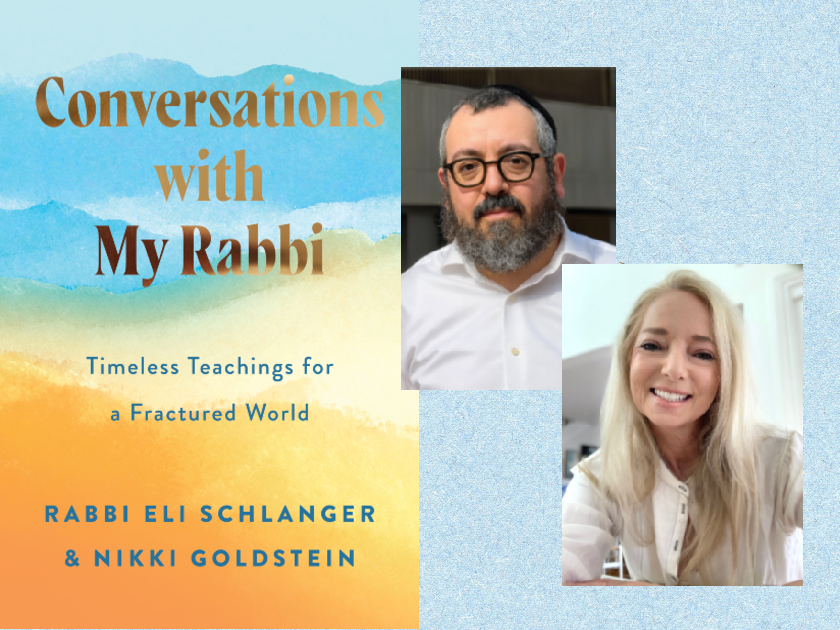
Rabbi Marc Katz spoke with Nikki Goldstein about Conversations with My Rabbi: Timeless Teachings for a Fractured World which she cowrote with Rabbi Eli Schlanger. Goldstein shares how she met Rabbi Schlanger and the profound impact he had on her life. Their conversations explore how Jewish wisdom can shape and uplift our everyday lives, connecting us across divides. Schlanger was tragically murdered at the Bondi Beach massacre in December of 2025. This powerful book captures Rabbi Schlanger’s boundless spirit of giving, compassion, and kindness.
Marc Katz: Why did you decide to write this book?
Nikki Goldstein: I don’t remember the first time I met Rabbi Eli Schlanger because I was in a coma. The second time I met him, I was awake and alive — though barely — and I was still in the hospital. When he saw me alive, he came directly to my bedside and pulled up a chair. He was surprised because the doctors had told my husband and daughter to prepare for the worst when they asked him to pray for me. He instantly called my recovery a miracle, and Eli considered his part in my survival as something very special, mystical, and powerful.
That miracle bound us from the moment we met, and drew us together in various ways over time. As he sat next to my bed, elated and filled with wonder at God’s mercy and mystery, he asked me what I did for a living. When I told him I was a journalist and author, he said, “Let’s do a book together.” He meant it, and over the next two years, he gently pursued the idea. Sometime late in 2024, I came up with the idea of recording and writing down our conversations. Eli was funny, clever, and fascinating. Then, in January 2025, he came to me with the idea of scaffolding our conversations around the Noahide Laws, the seven Laws God gave Noah after the flood to create a just and civil society. So, by late 2025, we had a solid concept for a book that incorporated our real-life, real-time conversations with Jewish wisdom.
Eli was very persuasive. He felt we were connected in a deep way through the miracle, and he said he’d wanted to write a book his whole life. Who was I to deny him that wish? Conversations With My Rabbi is different from anything else I’ve ever written, but I, too, felt the pull of the miracle and felt compelled to write about our unusual friendship, my surprising and thrilling burgeoning connection to the religion of my ancestors, and a celebration of Jewish wisdom.
MK: How did you come up with the conceit of writing a guide to Jewish thought and practice through the lens of the Seven Noahide laws? For the readers, can you also begin by defining them.
NG: Eli was devoted to the teachings of the Rebbe, Menachem Mendel Schneerson. The Rebbe had encouraged his adherents to celebrate and teach the Noahide Laws. Because the Noahide Laws are not just for Jews, but for everyone, the Rebbe saw them as a way to share Jewish wisdom with people outside the faith. A Jewish gift to the non-Jewish world, if you like. Eli had begun another initiative in Sydney, something he called “Project Noah”, which was a way to invite non-Jewish people (especially school kids) into the synagogue and teach them about the Noahide Laws. He felt it would be a bridge between worlds and a powerful way to combat antisemitism.
When he first told me about the Noahide Laws, I had never heard of them.
The Noahide Laws are not in the Torah itself. They’re implied in Genesis 9, where we learn of the covenant God makes with Noah after the flood. The formal list of seven laws can be found in theBabylonian Talmud (compiled roughly during 200 to 500 CE). So the Noahide Laws are rabbinic, not biblical. And largely unknown to secular and non-observant Jews. This is Talmudic territory, more familiar to the Orthodox. They are as follows:
Rabbi Eli was passionate about the Noahide Laws because he saw them as an enduring symbol of civility, morality, ethics, and connection to God. He fervently believed they offered a way to restore order and balance to a chaotic world. As modern humans, overwhelmed by division, noise, and moral relativism, the Noahide Laws offer something rare: clarity. They are not political. They are not dogmatic. They are deeply ethical, rooted in the idea that human beings are cocreators of a just world.
You don’t need to be Jewish to find meaning in them. In fact, these laws are specifically not Jewish in the ethnic or ritual sense. They are a spiritual framework for all of us — a way to bring more truth, compassion, and integrity into our lives, hearts, and communities.
They remind us that: life is sacred, justice is not optional, words matter, compassion is holy, and here is One Source behind it all.
They don’t require religious belief; rather, they ask us to live as if our actions matter. Because they do.
MK: Of the seven laws, represented as chapters in the book, which were the most eye opening for you?
NG: The Law (and chapter) that was the most eye-opening was the first one, which centers around the commandment “Do Not Worship Idols,” and which I ended up calling “Tell Me Why I Should Believe In God?”
Before Eli explained the Noahide Laws to me, I thought “Do Not Worship Idols” was about not bowing down to golden calves (from the Bible and every Cecil B. DeMille Hollywood movie). After learning that the commandment is actually about having a a deep personal relationship with one God, I was profoundly moved and excited by the idea. Eli showed me, not so much through his words, but by the way he moved through the world, what having a relationship with God looks like. And what it looks like is joy and goodness. He expressed his love for God and God’s love for him through daily acts of kindness, love, and compassion. He had a direct, dynamic relationship with God, and his devotion to one God was inspiring and powerful. That chapter changed my life.
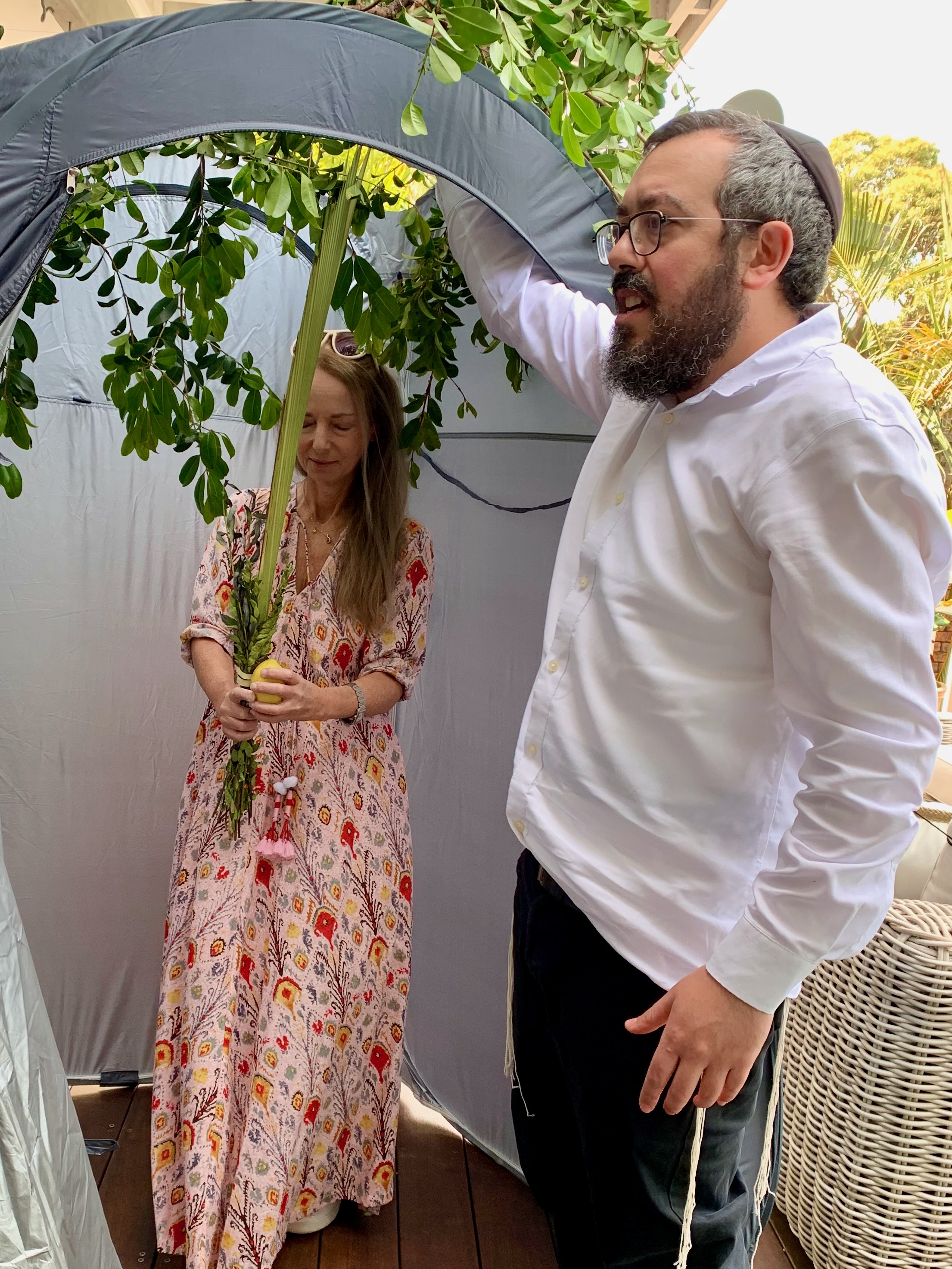
Nikki Goldstein and Rabbi Eli Schlanger during Sukkot
MK: You kept the book in dialogue format between you and Rabbi Schlanger. Why choose that format
NK: There are several reasons for using a dialogue format for the book. For a start, Eli wasn’t a writer, and he wouldn’t have had the time or patience for sitting down and endlessly drafting long passages of copy. He was a very vibrant, funny, charming, and electric man, best captured in real-time conversations. Secondly, our relationship grew out of conversations we mostly had on the phone. He was extremely busy, and he often called me for a chat when he was on the go — visiting a prisoner in a jail miles away, seeing a patient in hospital, or delivering food to the needy. He was always on the way to do all kinds of good, and he jammed in conversations with me — and many others — as he went about his daily work ministering to those who needed him. Our conversations record the man in his most natural state. Since his death, they’re now a record of who he was.
MK: What is the most urgent message in the book?
NG: Eli wanted the book to be about healing the world. He wanted to bridge the divide between Jewish and non-Jewish communities. I once asked him what his mission was and he simply said, “To bring light.”Then he asked me what mine was, and I said, “To bring love.” That’s the most urgent message in the book.
MK: How did the book change after the attack at Bondi Beach and Rabbi Schlanger’s murder?
NG: The book wasn’t completed when Rabbi Eli was murdered. We had only recorded six out of the seven conversations on each of the Noahide Laws, and there was still a lot to do. His father-in-law, Rabbi Yehoram Ulman, stepped in, and I interviewed him instead of Eli for the final chapter about creating courts of justice. I also needed to tell the story of what happened to Eli and the other fourteen victims of the Bondi Beach massacre. I used my journalism skills there and wrote contemporaneously about the funeral and Australian politics in the aftermath of the tragedy. But the main difference in the book is that I used the writing process as a kind of catharsis; I investigated my grief and my anger at what happened. Those sections were not in the previous incarnation of the book. Also, because Eli wasn’t around to help me with the religious checks, I was blessed by the introduction of Rabbi Zalman Shmotkin to the project, who ensured the book was correct from a religious point of view.
MK: How can we foster more of the intra- and inter-Jewish dialogue that this book seeks to model?
NG: Eli was the most amazing example of what it means to bridge the divide between Jews and non-Jews. His long-time assistant, Evie Summers, told me they were once at a local shopping centre when Eli caught sight of a Muslim Imam. He raced up to him, and asked how they might collaborate to bring Jews and Muslims together. Eli’s open-minded, optimistic, and compassionate approach to all people, regardless of race or religion, was a great example of how one person, one conversation at a time, can make a difference.
MK: One of the things one gains from reading the book is a real appreciation of Rabbi Eli Schlanger, both as a person and as a teacher. What else can you tell us about him that isn’t in the book?
NG: My words are a poor attempt to capture the radiance of the man. He wasn’t just good (though he was that in spades), he was Godly, and his Godliness was reflected in profound joy. No words can capture the exuberance of his spirit. It made people feel instantly warm and connected to him. After his funeral, his lovely wife Chaya told me, “It was a room full of Eli’s best friends.” Everyone loved him. He was the first to say he wasn’t a saint, but it’s a great loss to the world now that he’s gone. It’s like the sun collapsed and now there is a black hole. It’s my hope that the book can go some way to filling the hole that he left behind.
MK: If you had the ability to ask Rabbi Schlanger one final question, what would it be?
NG: I don’t have a final question for Eli because I feel he’s with me and I talk to him in my head, and sometimes out loud (I hope no one is listening!). If God intends for good people to become angels, I believe he has wings.
Rabbi Marc Katz is the Rabbi at Temple Ner Tamid in Bloomfield, NJ. He is author of the books Yochanan’s Gamble: Judaism’s Pragmatic Approach to Life (JPS) chosen as a finalist for the PROSE award and The Heart of Loneliness: How Jewish Wisdom Can Help You Cope and Find Comfort (Turner Publishing) which was chosen as a finalist for the National Jewish Book Award.