Join a community of readers who are committed to Jewish stories
Sign up for JBC’s Nu Reads, a curated selection of Jewish books delivered straight to your door!
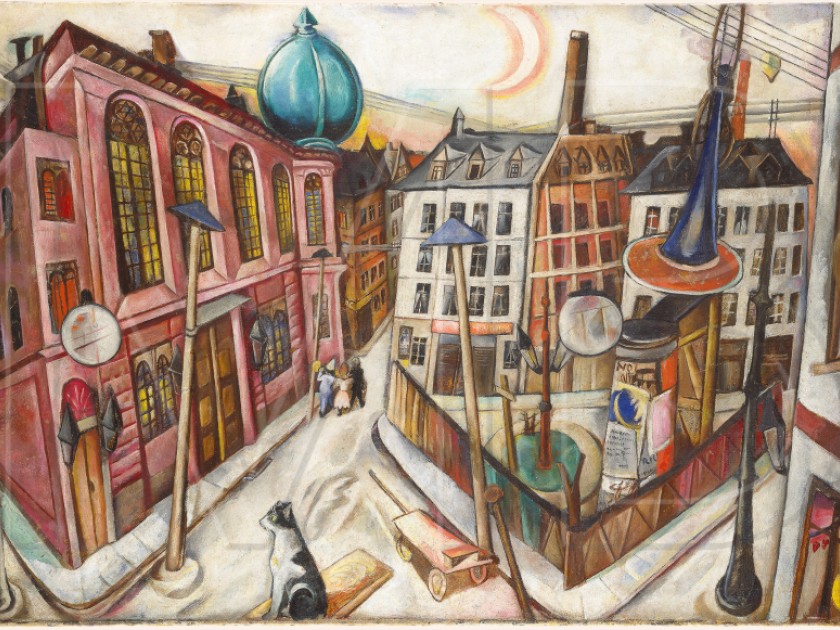
The Synagogue in Frankfurt on Main by Max Beckmann, 1919, Städel Museum Collection via Wikimedia Commons
During the late 1800s and early 1900s, American Jewish women participated enthusiastically in the rise of mass tourism. Technological improvements greatly increased the speed of ocean crossings; public and private investment led to a proliferation of railroad lines and hotels; and a new industry of guidebooks and package tours developed around the world. All these innovations significantly reduced costs, making travel more accessible to people other than the elite. Several generations of American Jewish women during this period went abroad for sightseeing, work, education, and family/heritage visits. Whether they visited the most common destinations in Europe or ventured further afield to Latin American, Asia, Africa, or prestate Palestine, they found that their intersecting identities as Americans, Jews, and women made their travel distinctive.
Travel served as another form of mobility during a period when millions of Jews worldwide were migrating to new places, offering an important avenue for Jewish diasporic encounter. In the modernizing world, diasporic cultures depended on travel to facilitate communication. Furthermore, American Jewish women engaged in a variety of activities that made their travel markedly Jewish, whether or not their Jewish identities predominantly shaped their lives back home.
One way in which Jewishness marked American Jewish women’s travel abroad had to do with the Jewish calendar. At the turn of the twentieth century, relatively few American Jews observed Shabbat — let alone other holidays throughout the year — in terms of refraining from work and a host of other activities, but sacred days still exerted a temporal influence on the choices travelers made while overseas, particularly during the High Holidays.
Not all American Jewish women who went overseas made Jewishness the central element of their travel. But a significant majority of them made sure to include at least some Jewish content in their journeys.
The frequency with which American Jewish women noted religious holidays in their diaries and correspondence is one example of an explicitly Jewish sense of time that intersected with their secular itineraries. Fourteen-year-old Alice Pentlarge’s 1909 travel journal was a minimalist affair, with only brief entries recording her activities in a parade of European cities, but she made special mention of “New Year’s Day” on September 16 and “Day of Atonement” on September 25.[1] Belle Lowenstein started keeping a diary of her round-the-world trip when she set out in December 1911 and made no mention of anything Jewish until August 28, when she spent a whole afternoon in the Tyrolean town of Bozen (now Bolzano in Italy) writing “New Year Postals” to her family in Cleveland ahead of the upcoming Rosh Hashanah on September 12.[2] Travelers who missed writing home before a major holiday felt guilty about the omission. In September 1934, Getrude Weil wrote apologetically from England to her mother in Goldsboro, North Carolina, “I am so sorry that I didn’t think of Rosh Hashana in time to get my message to you all…I thought of you often yesterday, which we spent in Chester. I found there was no synagogue there, so we went to the Cathedral!”[3]
Spending Rosh Hashanah in a cathedral was obviously not a typical experience. While it is likely that more American Jewish women overseas during the High Holidays marked the occasion in their diaries and wrote letters home than actually attended services, plenty of them went to synagogues, too. This reflected the fact that a substantial number of American Jews attended services on the High Holidays and kept up their usual practices while abroad. Birdie Stein, whose Baltimore family was traditionally observant, spent Rosh Hashanah of 1882 in Paris and went to the “immense, grand” Rothschild synagogue for the evening service the first night and then again for the morning services on both days.[4] Clara Moses, who only set foot in a synagogue back home in Natchez, Mississippi, on Yom Kippur, made a point of going to Yom Kippur services in Belfast during her 1912 trip abroad, even though she objected to the high price of the ticket.[5]
Some American Jewish women tried out more than one synagogue during the holidays. Miriam Arnold, in Frankfurt for Rosh Hashanah in 1887, went to the larger synagogue in the more modern building the first day but found the rabbi, Torah reader, and choir not entirely to her liking. On the second day she went instead to the “frümmer,” more traditional synagogue, which was crowded but more to her taste. The following week Miriam was in Heidelberg for Yom Kippur, where, she noted, “we all fasted remarkably well.”[6] Similarly, Henrietta and Sophie Szold attended two different synagogues when spending Rosh Hashanah in Vienna in 1909. On the first day they went to a synagogue that Henrietta dismissed as “gaudy,” though “fairly well-attended” and with a “not unattractive” service. On the second day they tried out a different synagogue where, she wrote later in her diary, the cantor was very good and the shofar blowing superb, but the women were distressingly talkative.[7]
For Miriam and Henrietta, attending High Holiday services was not a pro forma activity but a religious obligation, so the actual religious elements were worth commenting on. Other American Jewish women travelers had different intentions. Hannah Greenebaum Solomon arranged to spend Yom Kippur in Brussels during her 1923 round-the-world trip because she had heard the Reform synagogue there was a model of liberal Judaism, only to find it “more Orthodox than any in America.”[8] The experience underlined for her the stark differences between religious reform in the US and Europe. Rebecca Hourwich Reyher did not even have this much of a religious motive when she set out for Rosh Hashanah services in Cape Town immediately after arriving in South Africa in September 1924. She had encountered significant antisemitism on the voyage from the US and may have been seeking a kind of Jewish connection that normally did not interest her. She thought the building was impressive and at first appreciated the “quiet and singing inside,” but in short order she observed that “the women in their finery looked like transplanted Bronx…there was no Old World atmosphere” and left. Rebecca never denied her Jewishness but was quite alienated from any kind of religious practice or custom, so when the Cape Town synagogue did not live up to her rather stereotyped vision of what a High Holiday service should be like, she simply exited the scene.[9]
Even though Rebecca did not have a satisfying experience, the mere fact of her seeking out a synagogue in a faraway place exemplifies how many American Jewish women travelers felt themselves to be part of a global Jewish community at the turn of the twentieth century. Not all American Jewish women who went overseas made Jewishness the central element of their travel. But a significant majority of them made sure to include at least some Jewish content in their journeys. Travel thus became an important element of the Jewish diaspora during the late 1800s and early 1900s, just as the world began to seem a little bit smaller.
[1] Alice Pentlarge diary, September 16, 25, 1909, Box 1, Alice Pentlarge Kleeman Loeb Papers, 2011-M54, Schlesinger Library on the History of American Women (SL)
[2] Belle Loewenstein diary, August 28, 31, September 12, SC-17089, American Jewish Archives (AJA).
[3] Gertrude Weil, Windemere, to Mina Weil, Goldsboro, North Carolina, September 11, 1934, Box 21, Folder 8, Weil Papers, PC 1488, North Carolina State Archives.
[4] Birdie Stein diary, September 13 – 15, Box 7, Folder 141, Friedenwald Family Papers, MS 161, Jewish Museum of Maryland (JMM).
[5] Clara Lowenburg Moses, “My Memories,” SC-8499, 173, AJA.
[6] Miriam Arnold, “Summer Tour 1887,” Box 1, Arnold Diaries, UC 1884 2681, Temple University Special Collections.
[7] Transcript of Henrietta Szold diary, September 15, 17, 1909, Box 7, Folder 407, Szold-Levin Family Papers, MS 16, JMM.
[8] Hannah Greenebaum Solomon, Fabric of My Life: The Autobiography of Hannah Greenebaum Solomon (New York: Bloch, 1946), 199.
[9] Rebecca Hourwich Reyher, “Record of 1924 Trip to South Africa,” September 28 – 29, October 1, 1924, Box 10, Folder 9, Rebecca Hourwich Reyher Papers, MC 562, SL.