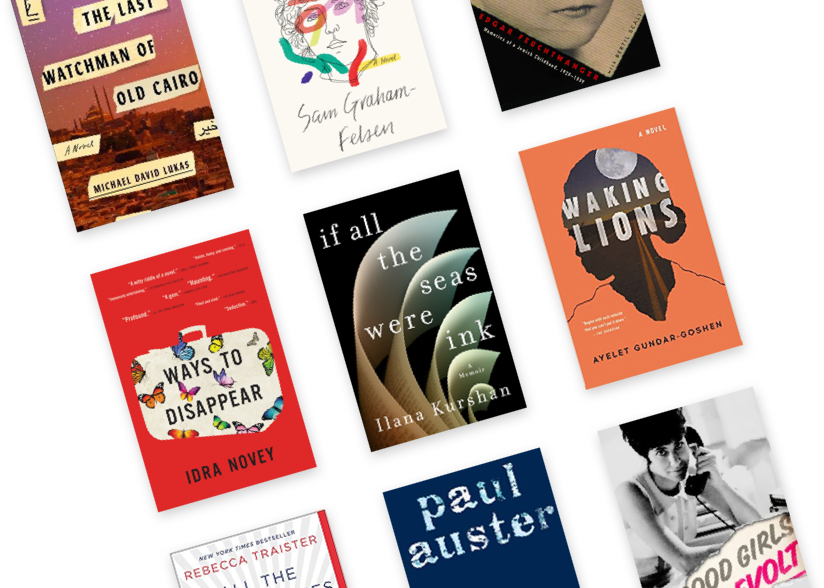
Alona Frankel, author of the best-selling Once Upon A Potty, now offers readers an insight into her own childhood. Her parents were educated, Polish Jewish Communists— “nonreligious Jews,” as her father put it. Alona was only two years old when the Nazis invaded Poland. When the ghetto was “liquidated,” a Christian family agreed to hide her mother and father in a workroom in their apartment, but wouldn’t allow them to bring their baby; a young child could make noise at the wrong moment and get everyone killed. So Alona’s parents paid a woman to pretend their daughter was Christian and board her in the countryside. Alas, when her parents’ meager resources ran out, the deal ended. The woman simply dropped off Alona at her parents’ hidden room where she wasn’t allowed, forcing Alona to hide from both the Nazis and from her parents’ host family. Still, the three of them survived and after the war restarted their lives in what became socialist Poland. This might have been a good fit for a pair of Communists, except the anti-Semitism problem hadn’t disappeared like it was supposed to. In the end there was only one viable option — aliyah.
The story of a girl hiding with her family in a secret room during the Holocaust, naturally brings to mind Anne Frank. But Frank was a teenager, confiding her thoughts and feelings to her diary. Alona was so young, she had to be taught a simplified, survival version of reality: there was a “war in the world,” and there was an “Aryan side of the world,” where Aryans had life but Jews got death (except she was not to use the term “Zyd” or Jew, but “the children of light” instead). While her family’s faith that “Tovarish Stalin” would save them was painfully ironic, it did stave off despair, which helped them survive. So there is a tragic difference between Anne Frank and Alona Frankel as well: the Nazis murdered Anne Frank, so she never had the chance to revisit her experiences from the perspective of an older woman, as Alona did.
Frankel tells her story in the voice of a child. Significant events are repeatedly retold, retold, and retold before the narrative moves forward, as if obeying some recursive storytelling rule never to go forward without taking a few steps backwards. As she recalls various incidents, she repeats key phrases (“I cried, cried, and cried”) three times, recalling the three wishes in fairy tales. Her reluctance to tell everything at once, a sort of stubborn withholding, almost prepares readers for her unpleasant stories. From the “coffin” she sleeps in, to her fascination with the fleas and lice and roaches and bedbugs she lived with, to the pair of mice she and her father “trained,” or the dead rat she adopted, the facts of the stories are reiterated again and again, each time with another detail added.
We are reminded that there is nothing linear about the process of memory, especially when it carries such enormous emotional weight. The trauma Frankel went through was real, even if it wasn’t acknowledged. It seeps out every time she describes the survivors who came to her parents’ apartment, who rolled up their sleeves so the numbers showed, and told the stories of the loved ones who did not make it. As Frankel says, “it was exhausting, depressing, repellent, boring. And it always made me feel guilty.”
Like many Holocaust memoirs, Frankel’s is filled with unresolved pain, but there is something about her childlike wisdom that makes us listen.
Related Content:
Bettina Berch, author of the recent biography, From Hester Street to Hollywood: The Life and Work of Anzia Yezierska, teaches part-time at the Borough of Manhattan Community College.